More than 40 people were killed and many others injured after two high-speed trains collided near Urda in Spain’s Toledo province on Wednesday, October 28, 2026, prompting a major rescue operation and the suspension of rail services between Madrid and Andalusia.
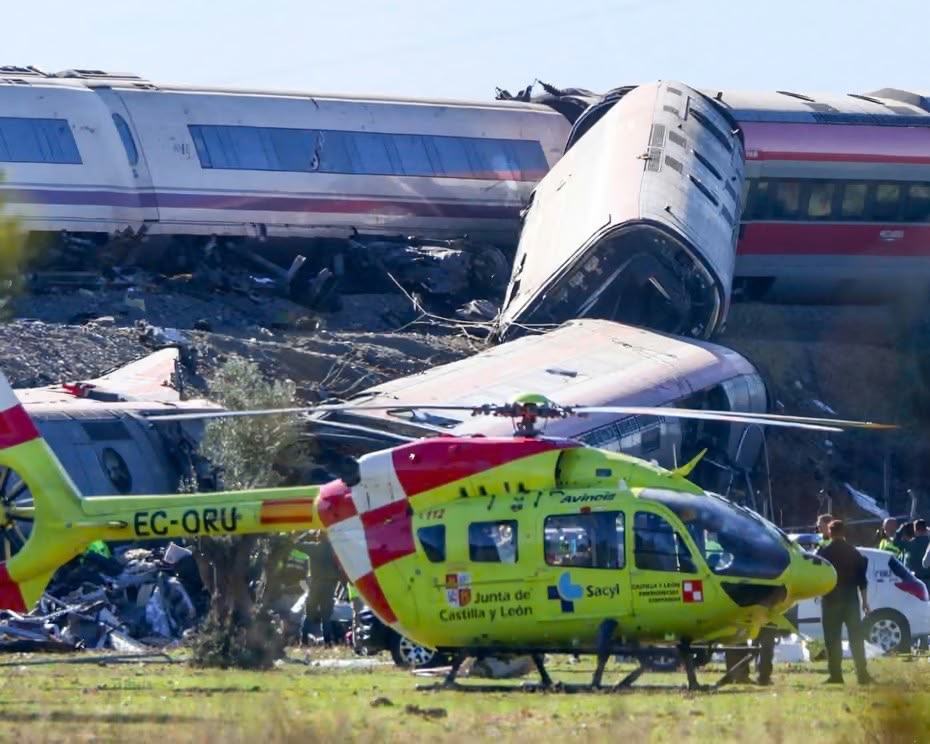
The crash occurred at approximately 8:54 a.m. local time on the Madrid–Seville high-speed railway line, when a Renfe AVE train struck the rear of an Iryo train that had stopped on the tracks. The collision caused several carriages to derail, with some tumbling down an embankment.
The two trains were carrying a combined 544 passengers, according to initial reports. The Renfe service had 397 passengers aboard, while the Iryo train was carrying 147 people, including a baby.
Emergency services deployed firefighters, Civil Guard officers, medical personnel and civil protection teams to rescue passengers and assist the injured. Medical helicopters and mobile intensive care units were also dispatched as authorities worked to reach those trapped in damaged carriages.
The scale of the disaster prompted authorities to mobilise additional medical resources, with hospitals in Madrid and Castilla-La Mancha preparing to receive casualties. Local authorities in nearby Urda were also asked to prepare a sports facility to accommodate people affected by the crash.
Spain’s railway infrastructure manager, Adif, suspended high-speed services between Madrid and Andalusia following the collision. The disruption affected passengers travelling to destinations in southern Spain, including Seville, while Renfe announced arrangements to assist affected travellers.
Prime Minister Pedro Sánchez expressed shock over the accident and said he remained in contact with Transport Minister Óscar Puente and Castilla-La Mancha regional president Emiliano García-Page.
In a statement shared on social media, Sánchez said emergency services were working at the scene to assist those affected and ensure their safety in coordination with the relevant authorities. He extended his solidarity and support to the victims and their families.
World Health Organization Director-General Tedros Adhanom Ghebreyesus also expressed condolences to those who lost loved ones, describing the incident as a heartbreaking day for Spain.
Tedros announced the cancellation of Wednesday’s events at the Global Obesity Summit in Madrid out of respect for the victims and to allow attention to focus on supporting their families.
The cause of the collision had not been officially established in the initial investigation. Railway safety experts discussed possible signalling and operational failures, but cautioned that these remained preliminary explanations rather than confirmed findings.
The disaster comes nine months after another deadly railway accident near Adamuz in Córdoba province, southern Spain. That January 2026 collision killed dozens of people and involved trains operated by Renfe and Iryo, drawing attention to railway safety across the country.
Investigators are expected to examine the circumstances surrounding Wednesday’s collision, including the movement of the trains and the railway systems in operation at the time. Rescue efforts and casualty assessments were continuing as authorities worked to establish the full extent of the disaster.