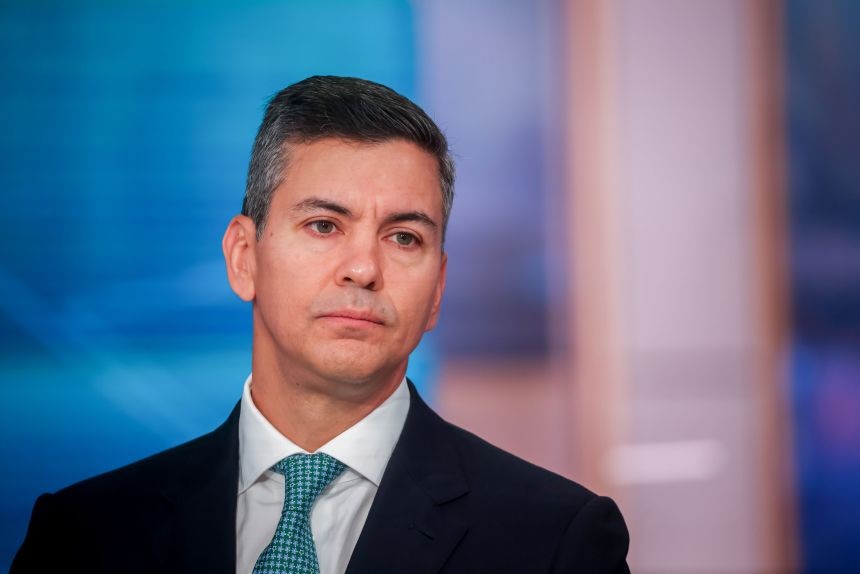
Paraguayan President Santiago Peña has resigned amid mounting pressure over the collapse of Ueno Bank, a financial institution linked to him, as lawmakers move to impeach him and prosecutors open criminal investigations into the crisis.
The bank was placed under resolution by Paraguay’s Central Bank on November 3 after regulators found that its solvency ratio had fallen below 50 per cent of the legally required minimum.
The intervention suspended its operations, leaving about 2.9 million customers unable to access their accounts and savings.
Peña announced his resignation on Thursday, saying he wanted to preserve national stability, social peace and the country’s democratic institutions. However, his decision did not halt the impeachment process.
The Chamber of Deputies unanimously approved the impeachment motion, with all 78 lawmakers present voting in favour. The Senate subsequently convened to begin the trial, which was adjourned until Friday morning.
The impeachment motion was brought by 35 opposition lawmakers and members of the ruling Colorado Party who had withdrawn their support for the president.
They accused Peña of serious and systematic dereliction of duty, citing alleged conflicts of interest, the placement of public pension funds in Ueno Bank and questions surrounding regulatory oversight.
Peña has denied wrongdoing and said he would appear before the Senate to defend himself with arguments and evidence, in accordance with the Constitution.
The controversy also spilt into a joint sitting of both chambers of Congress convened to consider his resignation.
However, the session was adjourned after lawmakers walked out, leaving the required quorum unavailable and preventing a decision on whether to accept his resignation.
This means his departure had not been formally settled by Parliament at the time of the latest reports.
Meanwhile, Attorney General Emiliano Rolón Fernández ordered a criminal investigation into the bank's supervision and resolution, the placement of public funds in the institution and the conduct of officials from various state agencies.
A special team of prosecutors was appointed to handle the probe.
Ueno Bank had approximately 2.9 million customers in a country of about 6.1 million people.
It also held substantial public funds, including money linked to the Social Security Institute, which manages pension and health-related resources for workers.
The Central Bank has since announced plans to begin processing deposit guarantee payments to eligible customers in phases, as authorities seek to address the financial disruption.
Peña, who took office in August 2023 for a five-year term, previously served as Finance Minister between 2015 and 2017 under former President Horacio Cartes. He also served as a director of the Central Bank.
The crisis has shaken confidence in Paraguay's financial sector, at a time when the country has been seeking to strengthen its position as a regional investment and financial hub.