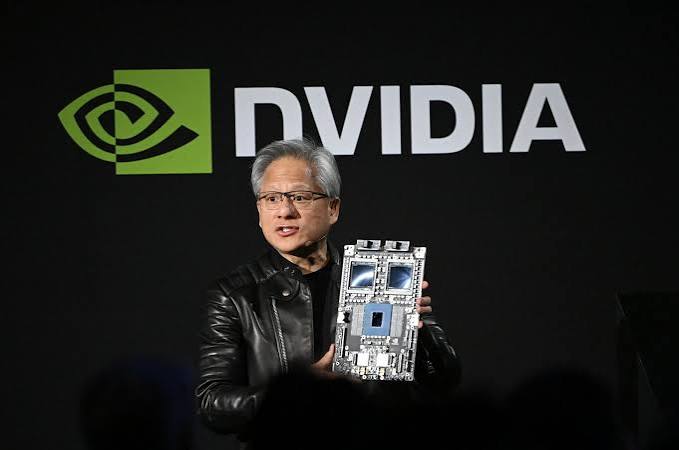
Nvidia has become one of the most influential companies in the United States, with its artificial intelligence chips powering a technology investment boom that is increasingly shaping economic growth, financial markets and America's global competitiveness.
The California-based semiconductor company reported record revenue of $115.8 billion for its third quarter of fiscal 2027, ended October 25, 2026, representing a 103% increase from the same period last year.
Its data centre business generated $107.6 billion, accounting for the bulk of sales as technology companies continue investing heavily in artificial intelligence infrastructure.
Nvidia's financial performance
Nvidia also projected fourth-quarter revenue of $130 billion, plus or minus 3%, signalling that demand for its computing products remains strong.
The company's importance comes from its position in the supply chain powering artificial intelligence. Its graphics processing units (GPUs) are used by technology companies including Microsoft, Google, Amazon and Meta to train and operate AI systems.
As these companies expand their data centres, demand increases for Nvidia's processors, advanced networking equipment, electricity, cooling systems and supporting infrastructure. This creates business opportunities for semiconductor manufacturers, construction companies, engineering firms and electricity providers.
Impact on US economic growth
The investment boom has also become a factor in US economic growth. A November 12 report by the Congressional Research Service identified AI-related investment in data centres, semiconductors and other infrastructure as a significant contributor to recent economic expansion.
However, the report cautioned that the contribution is difficult to measure precisely because official GDP statistics do not separately identify AI investment. It also warned that the spending boom could increase imports, inflation and borrowing costs, while a sudden reversal could destabilise parts of the economy.
Nvidia's influence extends to Wall Street, where its financial results are closely watched as an indicator of demand across the wider technology industry. Its latest earnings announcement on November 17 helped lift shares of other AI-related companies after the company issued a stronger-than-expected revenue outlook.
The company's strategic importance also extends to national security. Advanced semiconductors underpin military technologies, scientific research, cybersecurity and other applications central to America's technological competition with China.
Leadership changes at Nvidia
Nvidia's influence has also been closely associated with its co-founder Jensen Huang, who led the company for 33 years before resigning as chief executive on November 12. Chief Financial Officer Colette Kress was appointed interim CEO while the board searches for a permanent successor.
Huang's departure raises questions about leadership continuity at a company whose strategy and expansion have been closely associated with its founder. However, Nvidia's latest results suggest that its commercial momentum has continued through the transition.
For the United States, the bigger challenge is ensuring that the AI investment boom translates into sustainable productivity, jobs and broader economic benefits rather than leaving the economy excessively exposed to one industry.
Nvidia may not determine America's economic fortunes alone, but its growing influence shows how one technology company can shape investment decisions across an increasingly interconnected economy.