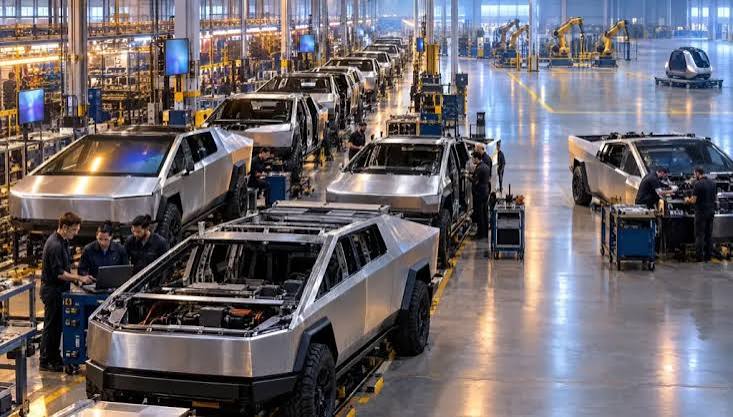
Tesla plans to increase Cybertruck production by introducing an additional factory shift as it races to fulfil outstanding customer orders before shutting down the electric pickup's production line around June or July 2027.
Chief Executive Elon Musk announced the decision on Saturday, November 7, saying the number of outstanding orders exceeded what the company could produce before dismantling the assembly line at its Gigafactory Texas facility.
"The Cybertruck order backlog is currently far more than we can make before dismantling the line for Cybercab expansion around June/July next year," Musk wrote in a post on X.
He added that Tesla would introduce an extra shift in an attempt to complete the outstanding orders before the deadline.
The move comes just a day after Musk disclosed plans to wind down Cybertruck production and redirect factory space, equipment and personnel towards manufacturing the Cybercab, Tesla's planned two-seat autonomous vehicle.
The shift reflects the company's broader strategy to move beyond conventional electric vehicle manufacturing and position itself as a major player in artificial intelligence, robotics and autonomous transportation.
The Cybercab is central to that ambition, with Tesla seeking to develop a vehicle capable of operating as a driverless taxi. Expanding its production will require manufacturing capacity and engineering resources currently allocated to other vehicles.
However, the Cybertruck's production wind-down comes despite Musk's latest claim that outstanding orders exceed the factory's remaining capacity. Tesla has not disclosed the precise size of the backlog or how many vehicles the additional shift is expected to produce.
The decision also highlights the gap between the expectations surrounding the electric pickup and its commercial performance. Musk initially projected that Tesla could eventually sell 250,000 Cybertrucks annually, but US sales fell to approximately 20,000 in 2025 from nearly 39,000 in 2024, according to Kelley Blue Book data cited by Reuters.
The vehicle began reaching customers in late 2023 after years of anticipation following its unveiling in 2019. Its unconventional stainless-steel design generated significant attention, but the pickup has faced repeated recalls, quality concerns and challenges expanding into international markets.
Tesla's latest production plans therefore present a complicated picture: the company says it has more outstanding orders than it can fulfil, yet it is preparing to discontinue the production line to prioritise another vehicle.
For existing customers, the additional shift could improve the chances of receiving vehicles before the planned shutdown. However, Tesla has not guaranteed that every outstanding order will be completed by the deadline.
The transition will be closely watched by investors as Tesla reallocates resources towards autonomous driving and robotics, businesses that Musk believes could eventually become more important to the company's long-term growth than conventional vehicle sales.