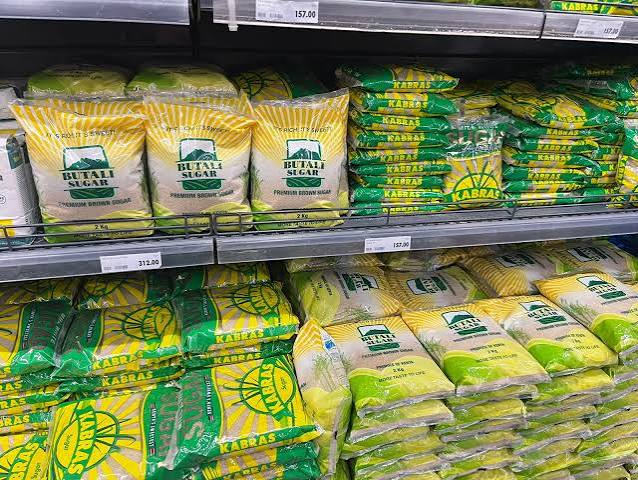
Kenyan households are paying less for sugar after domestic production increased by 56.7 per cent in the first nine months of 2026, easing pressure on supplies and reducing the country's reliance on imported sugar.
Data from the Kenya Sugar Board shows that local factories produced 690,521 tonnes between January and September, up from 440,652 tonnes during the same period last year. The increase represents an additional 249,869 tonnes entering the domestic market.
The higher output coincided with a decline in the national average retail price of sugar to KSh155 per kilogramme in September, compared with KSh171 in September 2025.
This means a household buying a two-kilogramme packet would spend approximately KSh310, against KSh342 a year earlier, saving KSh32. However, prices vary across retailers and locations, meaning the reduction is not necessarily uniform nationwide.
The production recovery was also reflected in the volume of sugarcane processed by factories. Millers handled 7.76 million tonnes of cane during the nine months, compared with 4.97 million tonnes in the corresponding period of 2025, an increase of 56.2 per cent.
The improved domestic supply has coincided with a significant reduction in sugar imports. Kenya imported 251,690 tonnes between January and September, down from 364,486 tonnes in the same period last year, representing a decline of about 31 per cent.
Imports of mill white and brown sugar recorded the sharpest drop, falling approximately 71 per cent to 65,845 tonnes from 226,730 tonnes.
However, imports of refined white sugar increased to 158,006 tonnes from 137,756 tonnes, showing that local production has not eliminated the need for imported supplies in certain categories.
The additional output has also strengthened inventories. Sugar stocks held by millers at the end of September stood at 70,773 tonnes, compared with just 14,033 tonnes a year earlier.
Cumulative miller sales increased by 45.6 per cent to 635,672 tonnes, indicating that more locally produced sugar was being sold into the market.
Kenya Sugar Board Chief Executive Officer Jude Chesire said the country was targeting production of 900,000 tonnes against annual consumption estimated at one million tonnes. This would bring the country closer to meeting domestic demand without depending as heavily on imports.
The improved performance could also create opportunities for the country to become a sugar exporter. Kenya exported 315.57 tonnes between January and September 2026, compared with 244.80 tonnes during the same period last year, although the volumes remain small relative to national production.
Chesire said Kenya expects to begin building exportable surpluses in 2027, making access to international markets increasingly important.
Beyond sugar, the recovery is creating opportunities for additional processing. Molasses production increased by 62.1 per cent to 307,617 tonnes during the nine-month period, potentially providing more raw material for ethanol and biofuel production.
For consumers, the immediate benefit is lower average retail prices. For the industry, however, the longer-term test will be sustaining production, improving factory efficiency and ensuring that higher output translates into reliable supplies, competitive prices and better returns for sugarcane farmers.