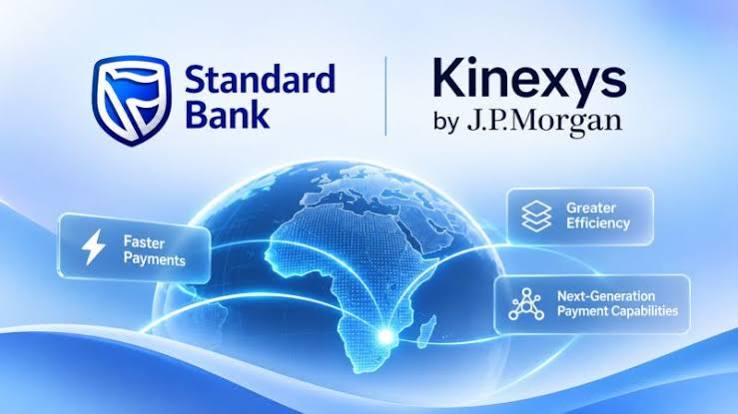
Standard Bank’s corporate and investment banking arm has signed a strategic collaboration with Kinexys by J.P. Morgan, giving it access to a blockchain deposit account network for client payments. The deal was announced in Johannesburg. The group says the network will support payments, liquidity management and other transaction services in Africa and beyond.
Kinexys is the blockchain business unit of J.P. Morgan. Its Blockchain Deposit Account network records bank deposits on a private shared ledger, so funds can move at any hour rather than only during banking hours. Standard Bank says the arrangement lets it combine that infrastructure with its African footprint and transaction banking services.
Standard Bank presents the move as part of a wider modernisation of its financial infrastructure. Richard de Roos, the group’s payments head, said businesses have become more interconnected and that moving funds quickly, securely and efficiently across markets has grown more important to clients. He said the platform gives the bank room to extend its payment capabilities and to add services in liquidity management over time.
Overview of the collaboration
For corporate clients, the immediate benefit is faster payment flows over an existing blockchain deposit network. The bank has not published the volume of payments it expects to route through the system, or the markets where it will go live first.
Kinexys reports more than $4 trillion in cumulative transactions since launch and average daily volume of about $7 billion. In June 2026 it added five Asia-Pacific currencies to its deposit network, allowing institutional clients to settle payments and foreign exchange around the clock.
Standard Bank is Africa’s largest lender by assets and operates through a network of franchises across the continent. Its earlier work on blockchain has focused on foreign exchange. Finextra has reported a private permissioned blockchain for overseas forex trades on behalf of corporate clients, built with ICBC and linked to Swift. The new arrangement extends that push into payments.
Implications for the Kenyan market
The announcement does not mention Stanbic Bank Kenya, the group’s Kenyan subsidiary. Any use of the platform in Kenya would need separate confirmation from Stanbic, and the regulatory treatment of blockchain deposits in Kenya would also have to be clarified under the country’s new virtual asset regime.
The partnership reflects a broader pattern. Banks are increasingly using tokenised deposit networks run by established global institutions rather than building their own. That approach can cut development costs, but it also ties African banks to the infrastructure and standards of a foreign provider.
Future developments to watch
The next signals will be the first live payment corridors on the platform, any Kenyan or other African rollout, and whether the bank discloses transaction volumes. Corporate clients and regulators will watch how the system performs against existing rails such as Swift.