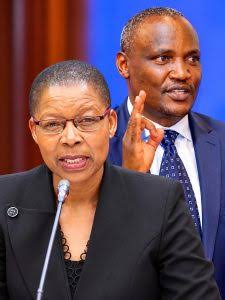
Treasury Cabinet Secretary John Mbadi and Attorney-General Dorcas Oduor have been found guilty of contempt of court for failing to comply with orders requiring the government to disclose Kenya’s sovereign bond agreements and explain how the borrowed funds were spent.
High Court Judge Patricia Nyaundi made the ruling on Thursday, November 19, 2026, directing the two officials to appear in person on November 27 at noon for mitigation and sentencing. The court also ordered them to personally pay the costs of the contempt application.
The case was brought by the Kenya Human Rights Commission (KHRC) and governance activist Wanjiru Gikonyo, who have been seeking information about sovereign bonds issued by the government over a nine-year period.
The dispute dates back to February 2022, when the petitioners requested copies of sovereign bond agreements, details of bondholders and beneficial ownership, conditions governing defaults, information on how the proceeds were spent and treaties relating to external borrowing.
In December 2024, Justice Lawrence Mugambi ruled that the government's failure to provide the information violated Kenyans' constitutional right to access information under Article 35. He also found that withholding the records breached the principles of openness and accountability in public finance under Article 201.
The judge ordered the government to release the requested documents and information within 45 days.
In the latest proceedings, Justice Nyaundi said evidence that the earlier judgment had been served on and acknowledged by the government had not been challenged. She also noted that Mbadi and Oduor had been given an opportunity to respond to the contempt application but had not filed responses.
The government had previously defended its handling of the request through an affidavit by former Treasury Principal Secretary Julius Muia. He argued that bond prospectuses were publicly available and that information on borrowing and expenditure could be found in budget documents and records submitted to Parliament.
However, the petitioners maintained that these materials did not provide the specific agreements and contracts they had requested.
The disclosure dispute has implications for public scrutiny of Kenya's borrowing, particularly the terms attached to external debt and the use of funds raised from international investors.
Kenya issued its debut $2 billion Eurobond in 2014, followed by subsequent sovereign bond sales. The first issuance was partly used to repay a syndicated loan, while the remaining proceeds were intended to support energy and infrastructure projects and reduce domestic borrowing.
The court's order seeks to establish greater transparency over such transactions, allowing citizens to examine the obligations the country has undertaken and how borrowed money has been utilised.
The November 27 hearing will determine the sanctions against Mbadi and Oduor. The court has also directed that the outstanding disclosure orders be complied with.