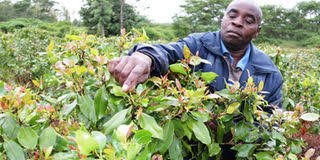
The government is seeking reliable markets for farmers through a value chain approach aimed at boosting their earnings. Food security official Dorothy Nditi, speaking in Chuka, said Kenya has adequate food production but farmers struggle to access markets. The government is encouraging farmers to diversify into other cash crops to reduce overreliance on muguka.
Muguka is a fast-growing variety of khat, a mild stimulant that farmers in central Kenya have increasingly planted in place of maize and beans. Its appeal is largely financial. One farmer in Kanyuambora told Business Daily that muguka brought in five times what he earned from maize or beans, and that he struggles to grow enough to meet demand.
The shift is widespread. Mbeere Muguka Farmers Sacco chairman Francis Kimori estimated that four out of every five households around Mount Kenya, including in Embu County, grow the crop in some quantity. Embu’s county government has previously put the number of muguka farmers in the region at about 65,000.
Officials have raised concerns about food security as a result. Nditi’s comments in Chuka reflect that worry, with the government now encouraging farmers to diversify. Her remarks on the muguka market suggest the crop’s returns are volatile, though the sources I reviewed do not describe the current market conditions.
Earlier, Embu County began distributing macadamia and avocado seeds to help farmers diversify their cash crops. Agricultural officials have argued that cash crops alone cannot lift farmers out of poverty, and that farmers should keep food crops to protect household food supplies.
Some farmers have warned that the shift may already be affecting food production. In Kirinyaga, one farmer said irrigation water for rice was being diverted to muguka fields. Other farmers have reported that the crop can grow in conditions where maize struggles, which helps explain its appeal.
The trend has also drawn criticism. Legislators in Mombasa and Kwale counties have pushed for sales and consumption bans over fears of addiction among young people. Those debates continue, and they make diversification a policy as well as a farming question.
Official data on the scale of the switch is limited. The Agriculture and Food Authority has said there is no official record of how many farmers have switched or how much land is now under muguka. That gap makes it harder to measure whether diversification efforts are working.
The next signals will be any government data on muguka acreage and any move by counties to fund alternative crops or market access. Farmers will want to see whether diversification brings reliable buyers as well as seeds.