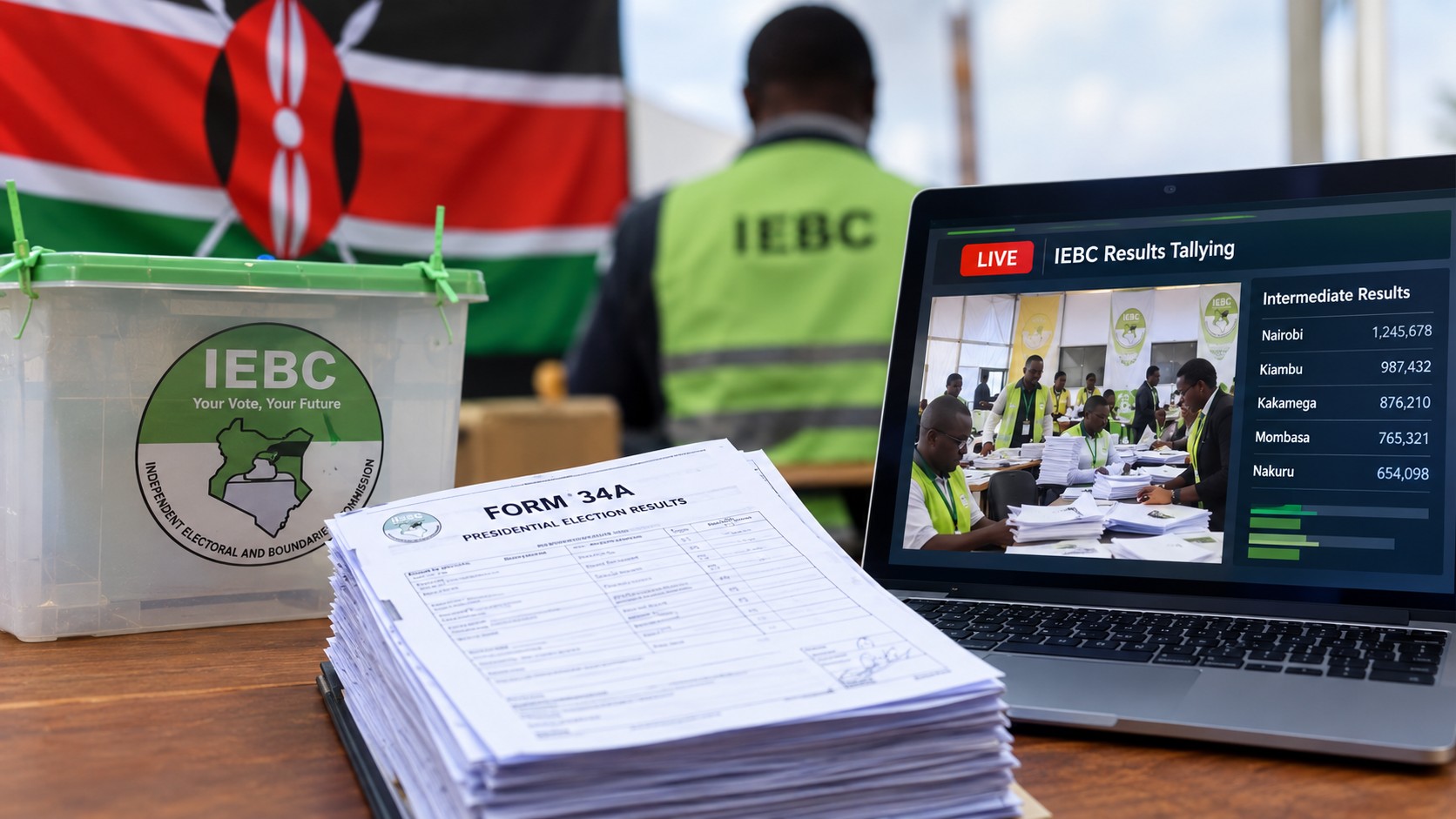
The Democratic Party has opposed Parliament’s move to remove the legal requirement for the Independent Electoral and Boundaries Commission (IEBC) to livestream election results as they are announced at polling stations, warning that the change could weaken public scrutiny ahead of the 2027 General Election.
In a statement, the party called on Parliament to reject the proposed changes, arguing that Kenyans must retain access to timely and verifiable information about election results.
“The Democratic Party unequivocally opposes any legislative proposal seeking to weaken electoral transparency by removing safeguards for the live transmission of election results,” the party said.
The opposition follows the National Assembly’s reported passage of the Elections (Amendment) (No. 2) Bill, 2024, on October 22, 2026. The Bill seeks to repeal and replace Section 39 of the Elections Act, which governs the determination, transmission and declaration of election results.
Clause 22 removes the express requirement for the IEBC to establish a mechanism for livestreaming results as announced at polling stations. The proposed framework, however, retains electronic transmission of presidential election results, verification requirements and the publication of polling-station results forms on a public online portal.
The change would therefore remove a specific legal obligation to broadcast results announcements live without necessarily ending electronic transmission or online access to result forms.
The Democratic Party cited Article 86 of the Constitution, which requires the electoral system to be accurate, verifiable, secure, accountable and transparent. The Constitution also requires votes to be counted, tabulated and announced promptly at polling stations, with results openly and accurately collated before being announced at subsequent tallying levels.
“Kenyans did not fight for multiparty democracy to be subjected to an electoral process shrouded in secrecy,” the party said, describing any attempt to weaken public scrutiny as an affront to constitutional democracy.
Livestreaming has enabled voters, political parties, journalists and election observers to follow the announcement of results at polling stations in real time. The public feed also provides an opportunity to compare figures announced at polling stations with results subsequently published or declared by the electoral commission.
The debate has historical significance following the 2017 presidential election dispute and the legal challenges surrounding electoral transparency.
In April 2018, the High Court declared unconstitutional a provision that restricted livestreamed results to public information and prevented them from forming the basis of the commission’s final declaration. The decision was subsequently upheld on appeal.
The earlier court dispute centred on the legal status of livestreamed results, rather than establishing that livestreaming itself should be removed. The current Bill proposes to omit the express livestreaming requirement from the replacement section.
The IEBC has previously maintained that the proposed changes would not eliminate electronic transmission of results and has indicated that it could still livestream results even if the law no longer expressly requires it.
The Democratic Party, however, warned that restricting public access to election information could create an information vacuum, fuel misinformation and erode confidence in electoral institutions.
The party said it would oppose the changes through parliamentary and constitutional avenues and demanded accountability from those sponsoring or supporting the proposed amendments.
Its opposition adds to the debate over how Kenya should balance the verification and management of election results with public access to the process. With the 2027 General Election approaching, the central question is whether the revised legal framework will preserve the level of public scrutiny previously provided by mandatory livestreaming.
The Bill’s reported passage by the National Assembly does not, on its own, establish that the amendments have become law. The formal legislative process, including presidential assent and commencement where applicable, remains relevant to determining the final legal position.