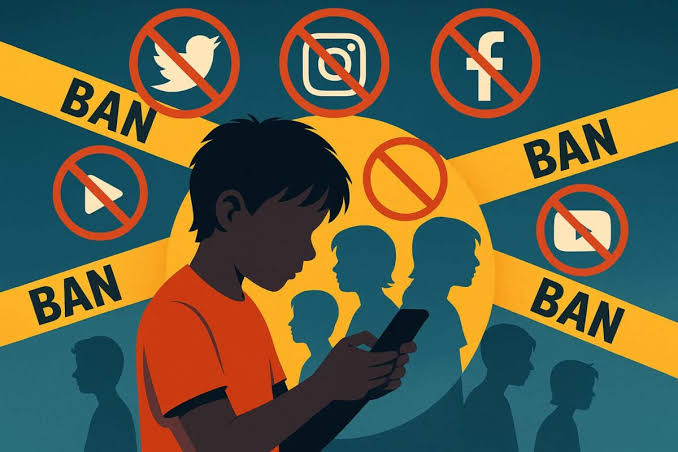
More than 20 countries have taken steps to restrict children's access to social media amid growing concern over addictive features and their impact on minors.
Governments around the world are moving to restrict children's access to social media, with several countries introducing outright bans, while others are considering tougher age limits and parental controls.
More than 20 countries have either introduced restrictions or are considering measures to limit children's access to social media, according to an AFP tally.
The European Union is the latest to intensify the push, with European Commission President Ursula von der Leyen expected to present proposals to the European Parliament aimed at protecting minors from social media features designed to keep users engaged for long periods.
Australia became the first country to introduce a blanket social media ban for children under 16, with the restrictions taking effect in December 2025.
However, data released in August indicated that some teenagers had found ways around the restrictions, highlighting the challenges governments face in enforcing age limits online.
Indonesia has also banned social media for under-16s, while Malaysia introduced similar restrictions in June.
Turkey has passed legislation barring children under 15 from social media, with the law expected to take effect later in 2026.
The United Arab Emirates announced a similar ban for under-15s, which is expected to be implemented in about a year.
Brazil has taken a different approach, requiring social media accounts belonging to users under 16 to be linked to their parents' accounts. Platforms are also required to verify users' ages.
China has progressively restricted children's online activity since 2019, initially imposing limits and curfews on online gaming before extending controls to social media and streaming platforms.
Several European countries are considering their own age restrictions.
Greece intends to prohibit social media access for children under 15 from January 2027, while Austria and Slovenia are preparing measures targeting children under 14 and 15 respectively.
Germany is considering several options, including age-based restrictions and rules targeting specific platforms.
Sweden is debating a proposal to prohibit social media use among under-15s by early 2028, while Denmark has announced plans to restrict access to several platforms for children under 15.
Ireland has also indicated that it could introduce its own legislation if an EU-wide solution is not reached.
France attempted to introduce an under-15 ban, but the country's Constitutional Council struck down the legislation on freedom-of-expression grounds. President Emmanuel Macron has pledged to pursue a new law by spring 2027.
Norway plans to present legislation that would prohibit social media access for children under 16.
Canada has unveiled a bill proposing 16 as the minimum age, while New Zealand has introduced legislation that would prevent social media companies from offering their services to under-16s.
Portugal, Spain and Italy are also considering legislation establishing minimum ages for independent access to social media.
In the United States, California has moved to tighten protections for children online. Governor Gavin Newsom signed a package of laws on September 10, including legislation preventing platforms from offering certain addictive features to users under 16. The measure is expected to take effect in early 2027.
The growing wave of restrictions reflects increasing concern among governments over children's exposure to potentially addictive social media features.
But the measures have also raised questions about enforcement, age verification, privacy and freedom of expression.
With more countries considering restrictions, the debate is increasingly shifting from whether children need greater protection online to how governments and technology companies can provide it without unnecessarily restricting young people's digital rights.