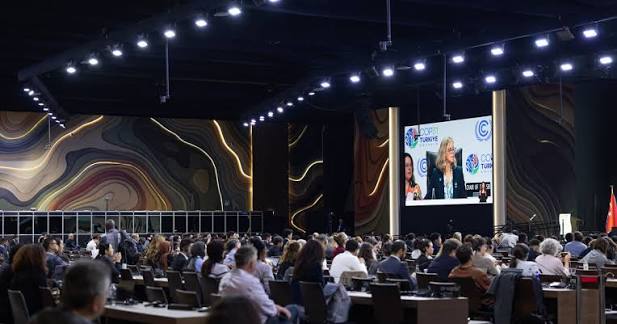
The COP31 climate summit in Antalya, Türkiye, has entered its second week with more than US$26 billion in green investment partnerships announced, as governments, development banks and private investors seek to accelerate renewable energy deployment and electrification.
The commitments include a preliminary US$15 billion renewable energy agreement between Türkiye and China, a planned US$6 billion investment by the European Bank for Reconstruction and Development (EBRD), and US$5.1 billion in financing agreements involving four multilateral development banks.
The China-Türkiye memorandum, announced on November 12, envisages investment in solar and wind power plants with a combined capacity of 7,000 megawatts. It also covers energy storage systems and 4,000 megawatts of electricity transmission infrastructure.
Turkish Energy Minister Alparslan Bayraktar said the cooperation would support renewable energy expansion and local manufacturing of wind power equipment. However, the agreement remains preliminary, with detailed implementation timelines and financing arrangements yet to be established.
The EBRD separately plans to invest US$6 billion over five years through Türkiye's Renewable Energy Acceleration and Clean Transition Platform (REACT). The initiative aims to mobilise US$300 billion by 2040 for renewable generation, electricity grids, energy storage, manufacturing and electrification.
The US$5.1 billion development-bank package includes agreements with the Asian Development Bank, Asian Infrastructure Investment Bank, World Bank and Islamic Development Bank, covering climate reforms, industrial investment, infrastructure and support for businesses.
Another major focus is the 35-by-35 Global Electrification Pledge, which seeks to increase electricity's share of global final energy consumption from approximately 23 per cent currently to 35 per cent by 2035.
The voluntary initiative promotes electrification across transport, buildings and industry, supported by modern electricity grids and expanded clean power generation. More than a dozen countries have publicly endorsed it, although support is not universal.
A major concern among developing countries is the cost of financing the transition. Some supporters have warned that electrification targets will be difficult to achieve without affordable capital, reliable infrastructure and stronger access to technology.
The summit has also seen the launch of the Electrify Now Finance Coalition, bringing together governments, development banks and investors to develop clean electrification projects in developing economies.
For African countries, the commitments carry particular significance as governments seek financing to expand electricity access, strengthen power networks and support industrial growth. However, the central test will be whether announced partnerships translate into funded projects, additional generation capacity and more affordable electricity.