The world is heading towards an exceptionally strong El Niño event, with the World Meteorological Organisation (WMO) warning that the phenomenon could exceed the scale represented on global monitoring charts, with far-reaching climate impacts expected to extend well into 2027.
In its Global Seasonal Climate Update released on October 20, 2026, the WMO forecasts a further intensification of El Niño between November 2026 and January 2027, with sea-surface temperatures in the central and eastern equatorial Pacific expected to rise significantly above normal levels.
The organisation's multi-model forecasts indicate that the Niño 3.4 sea-surface temperature anomaly could reach approximately 3.8 degrees Celsius during the November-January period, peaking around December 2026.
This would mark a substantial increase from the observed seasonal average of 2.4 degrees Celsius between July and September 2026, as warming across the equatorial Pacific continues to strengthen.
El Niño is a naturally occurring climate phenomenon associated with the periodic warming of sea-surface temperatures in the central and eastern tropical Pacific Ocean. It influences atmospheric circulation patterns and can disrupt normal rainfall and temperature patterns across different parts of the world.
The WMO outlook points to widespread shifts in global temperatures, with an increased probability of above-normal temperatures across large parts of Africa, Asia, Europe, the Americas and Australia during the November 2026-January 2027 season.
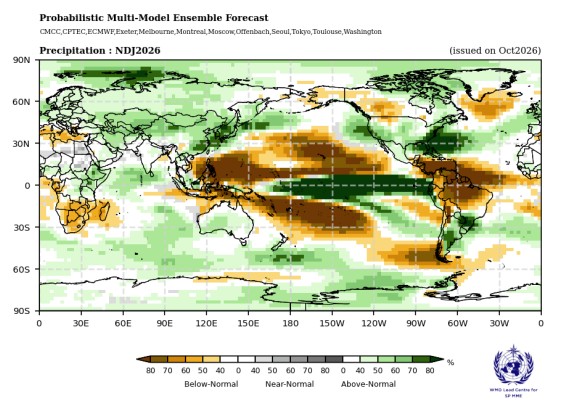
Africa is among the regions expected to experience warmer-than-normal conditions, with particularly strong signals across the continent and the equatorial region. The forecast also indicates an increased probability of above-normal rainfall across the Greater Horn of Africa, raising the prospect of a wetter-than-usual season in parts of the region.
However, the WMO cautions that seasonal forecasts describe probabilities rather than certainties. Actual weather conditions may differ from the most likely outcomes shown in its projections.
Beyond Africa, the outlook identifies a strong likelihood of above-normal rainfall across parts of the central and eastern equatorial Pacific, while below-normal rainfall is favoured across extensive areas of the western Pacific and equatorial Atlantic.
Other regions are also expected to experience contrasting conditions, reflecting the complex influence of El Niño on global climate systems.
The WMO says the forecasts are based on a multi-model ensemble drawing on several international seasonal prediction systems. The models show strong agreement on the intensification of El Niño, providing a high level of confidence in the projected ocean warming.
Meanwhile, the positive Indian Ocean Dipole, another climate driver that can influence rainfall across East Africa, is forecast to weaken towards near-normal conditions during the November 2026-January 2027 period.
The WMO stresses that its Global Seasonal Climate Update provides broad guidance for regional climate centres and national meteorological services rather than an official forecast for individual countries. National and regional outlooks should therefore be consulted for more specific information on expected local conditions.
It comes as Kenya is set to experience rainfall in 46 counties . The weatherman says several parts of the country are expected to receive rainfall over the next seven days, with isolated storms likely in parts of the Coast and Northeastern regions, raising the risk of flash floods.