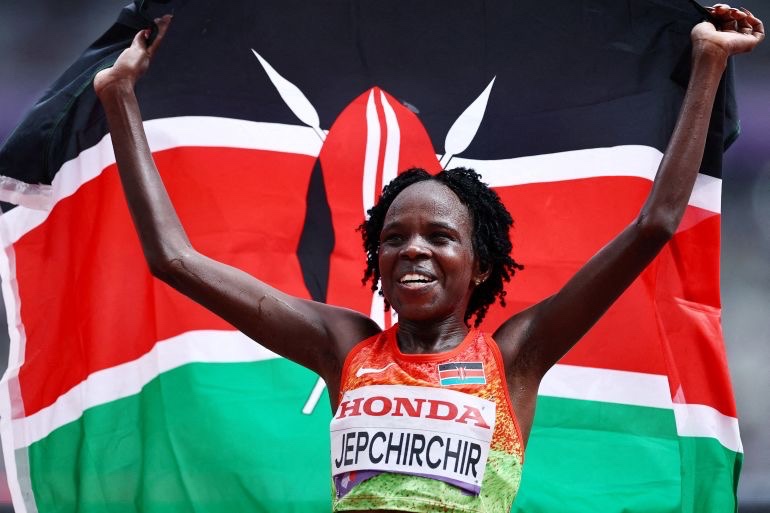
Reigning world marathon champion Peres Jepchirchir has been handed a three-year ban by the Athletics Integrity Unit (AIU) for anti-doping rule violations involving erythropoietin (EPO), alongside compatriots Veronica Loleo and Ronald Kipkoech Korir, who received three- and six-year suspensions respectively.
The AIU announced the sanctions on Thursday, November 19, 2026, with all three athletes facing disqualification of competitive results dating back to different periods.
Jepchirchir’s suspension took effect on October 20 after an out-of-competition sample collected in Kenya before her victory at the Sydney Marathon returned an adverse analytical finding for EPO on September 17.
The 33-year-old was provisionally suspended following the finding. During an interview with the AIU, she initially denied using the prohibited substance and said she did not know how it had entered her system.
However, she subsequently admitted the anti-doping rule violations and accepted the consequences, including the disqualification of all her competitive results dating back to July 17, 2026.
The decision strips her of the Sydney Marathon title she won on August 30 after clocking 2:18:31 in the women’s race. Her compatriot Irine Cheptai, who finished second, is set to be recognised as the 2026 women’s champion.
Jepchirchir, who won Olympic marathon gold at the 2021 Tokyo Games and the 2025 World Athletics Championships title, received a three-year suspension following a reduction from the standard four-year ban after admitting the violations and accepting the consequences.
Loleo also received a three-year ban for EPO-related violations, with her suspension taking effect on October 22, 2026.
The Kenyan runner returned adverse analytical findings from blood and urine samples collected out of competition on September 6. During an interview with the AIU, she denied knowing how the findings had occurred but disclosed that she had received an injection to treat an injury and associated pain before the samples were collected.
She could not recall the medication’s name but subsequently admitted the anti-doping violations and accepted the consequences.
Her disqualification covers all competitive results dating back to September 6, 2026, including her second-place finish in the women’s half-marathon at the 2026 World Road Running Championships, where she won silver.
Like Jepchirchir, Loleo received a one-year reduction from the standard four-year suspension after admitting the violations and accepting the consequences.
Unlike the two athletes whose cases involved EPO, Korir received a six-year ban following abnormalities detected through his Athlete Biological Passport (ABP), an anti-doping monitoring system that tracks changes in an athlete’s biological markers over time.
The AIU analysed 20 blood samples collected from the 35-year-old between May 6, 2023, and August 18, 2025. A panel of experts identified abnormal values in samples taken between January and March 2024 and again in January and February 2025, concluding that the pattern was consistent with the use of a prohibited substance or method.
Korir was asked to provide written explanations but failed to do so despite being given opportunities to respond. He was formally charged on September 25, 2026, and provisionally suspended.
His failure to respond to the charge within the stipulated period meant he waived his right to a hearing and was deemed to have admitted the violation and accepted the consequences.
His six-year suspension took effect on September 25, with all competitive results dating back to January 19, 2024, disqualified.
Commenting on the cases, AIU Chief Executive Brett Clothier acknowledged progress made by Kenyan authorities in fighting doping but warned that more work remained.
“The Kenyan authorities have made a lot of progress in the fight against doping in the last five years, but these cases highlight that there is still a long way to go,” Clothier said.
He added that the Kenyan government had committed to strengthening the Anti-Doping Agency of Kenya (ADAK) and addressing criminal networks facilitating doping in the country.
The AIU said it would discuss the details of the government’s commitments with Kenyan authorities in the coming months.
The latest suspensions add to scrutiny facing Kenyan athletics as the country prepares to host the 2029 World Athletics Championships in Nairobi, becoming the first African nation to stage the global competition.