The World Health Organization (WHO) has recommended the addition of two experimental Ebola vaccines to an ongoing clinical trial in the Democratic Republic of the Congo (DRC) as efforts to contain the Bundibugyo virus outbreak gather pace.
The two candidates, ChAdOx1 and mRNA-1469, will be evaluated in the Tumaini clinical trial following approval by the relevant national authorities.
The recommendation was made by WHO's independent Technical Advisory Group on Candidate Vaccines Prioritization after reviewing available preclinical and early clinical evidence.
ChAdOx1 was developed through a partnership between the University of Oxford and the Serum Institute of India, while mRNA-1469 is produced by American biotechnology company Moderna.
The inclusion of the candidates marks the first time vaccines specifically designed to protect against the Bundibugyo virus will be assessed during an outbreak caused by the strain.
WHO Director-General Dr Tedros Adhanom Ghebreyesus welcomed the progress, describing it as evidence of what scientific research and international cooperation can achieve in responding to emerging health threats.
He thanked scientists, healthcare workers and partners in the DRC and other countries for their contribution to vaccine development and clinical research.
Tedros also recognised people participating in the trial, saying their involvement would help generate evidence that could guide future efforts to save lives.
However, he cautioned that vaccines alone would not bring the outbreak to an end, noting that they could become an important additional tool in controlling the spread of the disease.
The Tumaini trial is being led by the DRC's Institut National de Recherche Biomédicale (INRB), with support from the University of Antwerp in Belgium, WHO, Epicentre, Médecins Sans Frontières, the Institute of Tropical Medicine of Antwerp and the Africa Centres for Disease Control and Prevention.
The development of the vaccine candidates has also benefited from investments by the Coalition for Epidemic Preparedness Innovations (CEPI), which supports research aimed at preparing for future disease outbreaks.
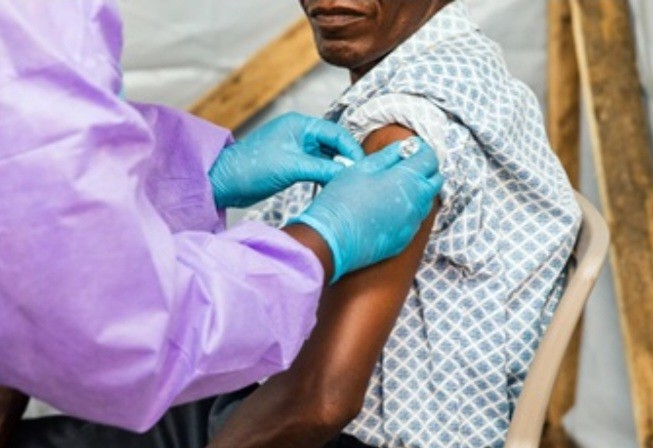
Tumaini is designed to evaluate several vaccine candidates within one clinical study, using a ring-vaccination approach. Under this method, people who have been in contact with confirmed Bundibugyo virus disease patients are identified and enrolled for vaccination.
The strategy builds on an approach used during the West Africa Ebola outbreak about a decade ago. A landmark trial in Guinea established the effectiveness of Ervebo against the Zaire ebolavirus, leading to its use as a vaccine against that strain.
Ervebo is now the first vaccine being assessed in the Tumaini trial to determine its effectiveness against the Bundibugyo virus.
According to WHO, four vaccination rings have already been established, with additional groups being prepared. They include contacts of people who developed the disease or died from the infection.
Meanwhile, research into possible treatments for patients infected with the virus is also progressing.
The WHO-supported PARTNERS trial, launched in July, is assessing whether the monoclonal antibody MBP134, the antiviral drug remdesivir or a combination of the two can improve survival among patients with confirmed Bundibugyo virus disease.
Another treatment, maftivimab, is expected to be added to the study to assess its potential benefits. A separate post-exposure prevention study involving obeldevisir is also underway.
WHO is supporting the research through its Research and Development Blueprint and Health Emergencies Programme. Its role includes helping develop research protocols, offering technical guidance, coordinating participating institutions and providing operational support to ensure studies meet scientific and ethical standards.
Initial findings from the treatment trials are expected in the coming months, while results from the vaccine trial are anticipated in early 2027.