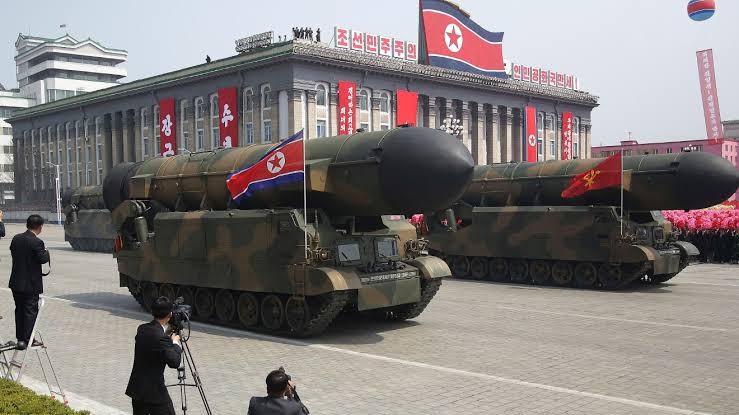
North Korea fired multiple ballistic missiles toward the East Sea on Monday, October 12, South Korea’s military said, as tensions with Seoul remained high after a landmine blast injured three South Korean soldiers near the heavily fortified border.
The launch came amid a recent exchange of weapons tests. North Korea fired an intermediate-range missile on October 3, and South Korea tested a domestically developed hypersonic glide vehicle on October 9. Seoul said the North’s latest launch may have been a protest against the South’s test and a display of Pyongyang’s missile capabilities.
South Korea’s Joint Chiefs of Staff said it detected the launches from the Pyongyang area at about 9:20 a.m. local time. At least one missile flew more than 900 kilometres, the JCS said. It did not specify how many missiles it detected or release full flight details, saying analysis was continuing.
Japan’s Deputy Defence Minister Takashi Koyari said Japan detected two missiles launched 17 minutes apart. He said the first flew about 220 kilometres and the second more than 910 kilometres, following an irregular flight path that could indicate a hypersonic weapon. Japan assessed that both landed outside its exclusive economic zone and reported no damage to aircraft or vessels.
South Korea’s military said it had increased surveillance and readiness following the launches. The presidential National Security Office convened an emergency meeting and called on Pyongyang to stop its ballistic missile launches, which violate United Nations Security Council resolutions.
The latest missile activity follows a September 21 landmine explosion in the Demilitarized Zone, where three South Korean soldiers were injured while working on a patrol route. On October 5, South Korea’s military said a joint investigation with the United Nations Command concluded that mines planted by North Korea caused the blast. Seoul cited forensic evidence and another mine found near the site. North Korea denies responsibility and has rejected South Korea’s demand for an apology.
The two Koreas remain technically at war because the 1950–53 conflict ended in an armistice, not a peace treaty. The DMZ is a heavily fortified buffer zone between them. North Korea has rejected recent U.S. and South Korean overtures to resume diplomacy, while leader Kim Jong Un continues to expand the country’s nuclear and missile programmes.
Pyongyang said October 3 missile used artificial intelligence and could manoeuvre at low altitude. The missile’s range remains disputed among Seoul, Tokyo and Pyongyang.