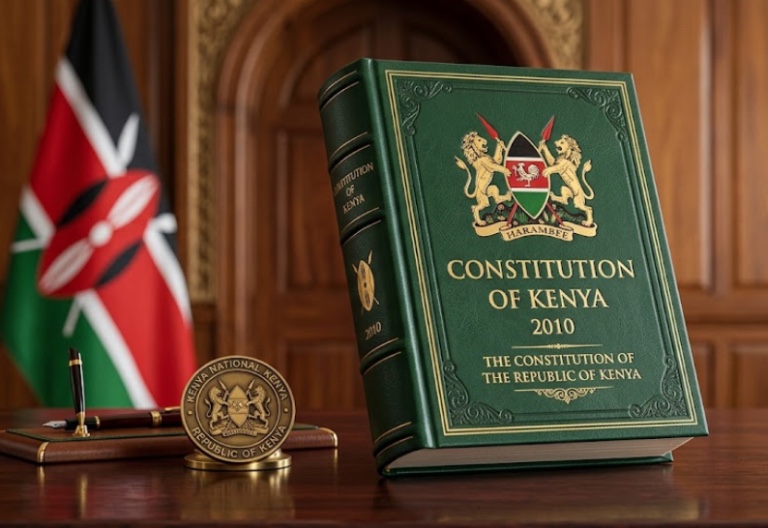
As Kenya marks Mashujaa Day on October 20, the country faces a continuing test of whether the promises of the 2010 Constitution are being realised in citizens’ everyday lives.
Devolution has redistributed power, the Bill of Rights has expanded constitutional protections, and oversight institutions have formal mandates.
However, persistent concerns over human rights, equality and public accountability show that implementation remains as important as the law itself.
Before the constitutional change, October 20 was known as Kenyatta Day, honouring Kenya’s first president, Jomo Kenyatta, and his role in the independence struggle.
Kenyatta was arrested on October 21, 1952, during the colonial government’s crackdown on nationalist leaders. He and five others later became known as the Kapenguria Six.
The 2010 Constitution renamed the holiday Mashujaa Day, broadening its significance to recognise Kenyans whose courage and contributions have shaped the country. Article 9 formally establishes October 20 as a national day.
The change reflects a wider understanding of heroism, extending recognition beyond individual political leaders to citizens who contribute to Kenya’s development and freedoms.
The occasion therefore provides an opportunity to assess not only the country’s history but also its progress in fulfilling the constitutional principles that followed independence.
Devolution Has Brought Power Closer to Citizens
The establishment of 47 county governments was among the Constitution’s most significant reforms. Devolution created opportunities for local participation and gave counties responsibility for functions including county health services, agriculture and local development.
The system was intended to address historical regional inequalities and make public services more responsive to local needs.
However, differences in service delivery, concerns over pending bills and financial management, and corruption allegations continue to test whether devolution is delivering its intended benefits.
The challenge is no longer simply establishing county governments but ensuring they use public resources effectively and transparently.
Devolution has changed how power is distributed, but its success must be measured through accessible services, accountable leadership and equitable development.
The Constitution provides for multiparty democracy, separation of powers and public participation.
The principles are intended to give citizens influence over government decisions while enabling Parliament, the Judiciary and independent institutions to scrutinise the exercise of power.
The 2024 protests against the Finance Bill demonstrated the influence of public participation.
Following widespread opposition, President William Ruto announced on June 26, 2024, that he would not sign the Bill, acknowledging public concerns.
Parliament subsequently rejected it in its entirety.
The episode showed that citizens can influence national policy beyond elections.
However, the protests also raised serious concerns about the protection of peaceful assembly and the conduct of security agencies.
A functioning democracy requires both responsive leadership and respect for constitutional freedoms, including when citizens challenge government decisions.
Chapter Four of the Constitution guarantees rights covering life, dignity, security, expression, healthcare, education and other essential freedoms.
Yet legal recognition has not eliminated violations or barriers to accessing basic services.
In its State of Human Rights assessment covering December 2024 to December 2025, the Kenya National Commission on Human Rights reported receiving 2,848 complaints.
Economic, social and cultural rights accounted for the largest reported category, with 1,381 complaints. The Commission also raised concerns about killings, arbitrary detention, torture, abductions and enforced disappearances.
These figures represent complaints received, not a complete count of all violations. Nevertheless, they underline the importance of effective investigations, access to justice and accountability for alleged abuses.
Constitutional rights can only provide meaningful protection when institutions act on violations and citizens can seek remedies without fear.
Article 27 guarantees equality and freedom from discrimination, while requiring measures to address disadvantage. However, women remain underrepresented in elected legislative institutions.
The Kenya National Bureau of Statistics’ Economic Survey 2026 reported that women held 23.6 per cent of National Assembly seats, 31.3 per cent of Senate seats and 34 per cent of county assembly seats at the end of 2025.
These figures show that women’s representation remains below the Constitution’s two-thirds gender principle in these legislatures.
Addressing the gap requires more than legal commitments; political parties and institutions must confront barriers that prevent equal participation.
The broader constitutional promise also includes marginalised communities and people with disabilities, whose access to services, representation and opportunities remains an important measure of equality.
The Constitution established oversight mechanisms to scrutinise public spending and the conduct of state institutions.
The Office of the Auditor-General’s 2024/25 Annual Corporate Report states that it submitted 2,746 financial audit reports to Parliament and county assemblies, alongside 27 special audit reports.
These reports demonstrate the scale of financial scrutiny, but producing audits is only one stage of accountability.
Their findings must be examined, recommendations acted upon and suspected wrongdoing investigated through appropriate procedures.
Without effective follow-up, oversight risks becoming an administrative exercise rather than a deterrent to waste and misuse of public funds.
As Kenya celebrates its heroes, the constitutional test remains whether citizens experience responsive services, protected freedoms, fair representation and transparent government.
Mashujaa Day honours past sacrifice, but fulfilling the promises of the 2010 Constitution requires sustained action from leaders, institutions and citizens alike.