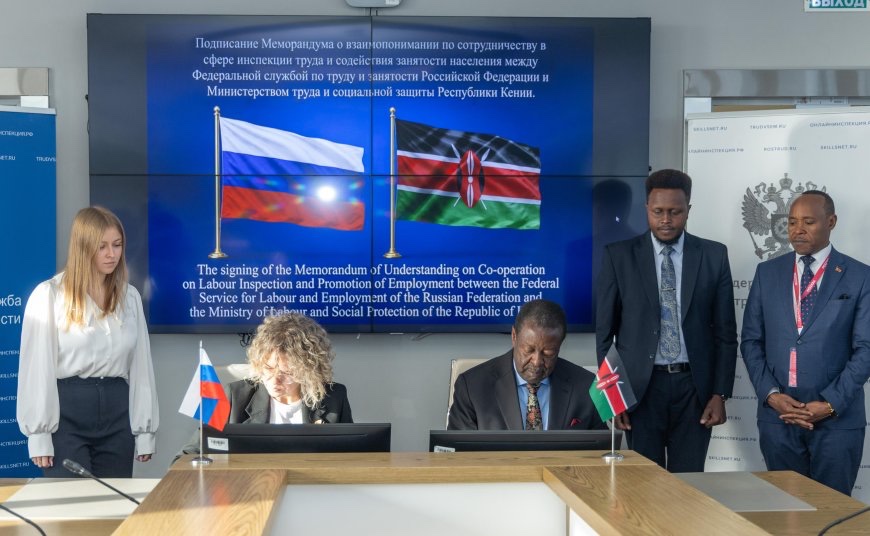
Kenya and the Russian Federation have signed a Memorandum of Understanding (MoU) aimed at strengthening cooperation in labour inspection, expanding employment opportunities and improving the protection of workers in both countries.
The agreement is expected to enhance labour administration systems, strengthen regulatory oversight and promote compliance with labour laws, including workplace safety and occupational health standards.
The MoU was signed in Moscow, with Russia represented by Ms Irina Zubkova, the Acting Director General of the Federal Service for Labour and Employment (Rostrud).
It establishes a framework through which Kenya and Russia will exchange knowledge, technical expertise and best practices in labour inspection, enforcement of labour laws, investigation of workplace accidents and management of occupational risks.
The partnership will also focus on the use of digital technologies to modernise labour inspection operations and improve employment services for employers, job seekers and unemployed persons.
Under the agreement, the two countries will facilitate the exchange of regulatory documents, information and professional expertise. They will also organise joint consultations, meetings, seminars and conferences to strengthen institutional capacity and improve the performance of their labour institutions.
Speaking during the signing, Dr. Musalia Mudavadi said the partnership is expected to improve the accessibility and quality of services provided by public employment agencies through digitalisation and better service delivery systems.
To ensure the agreement is implemented effectively, Kenya and Russia will establish a Joint Committee comprising senior officials from the participating institutions within 60 days of signing the MoU.
The committee will be responsible for monitoring progress, coordinating activities and reviewing the implementation of agreed areas of cooperation. It will meet at least once every year or whenever both countries agree to hold additional meetings.
The agreement further provides that all cooperation activities will be carried out in accordance with the respective national laws and international obligations of both countries. Implementation will also depend on the availability of resources and arrangements mutually agreed upon by the two parties.
Dr. Mudavadi described the signing as another important step in strengthening bilateral relations between Kenya and Russia, particularly in technical cooperation, institutional capacity building and the exchange of expertise.
He noted that the partnership provides Kenya with an opportunity to learn from Russia’s experience in modernising labour administration, improving workplace safety and strengthening employment services.
The agreement comes as the Kenyan Government continues to prioritise decent working conditions, skills development and the creation of more employment opportunities for citizens.
Through the partnership, Kenya hopes to strengthen the systems responsible for protecting workers while improving the services available to employers and people seeking employment.