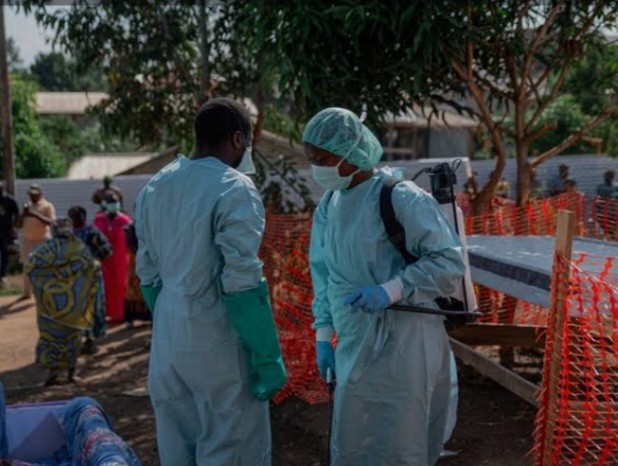
Health authorities are investigating whether Ebola patients in Kenya and Nigeria may have crossed paths at Uganda’s Entebbe International Airport on October 3, as efforts intensify to establish how the two infections occurred.
The Africa Centres for Disease Control and Prevention (Africa CDC) says investigators are examining whether the patients may have had contact at the airport, including through shared equipment or facilities. However, officials caution that no connection between the two cases has been established.
Dr Wessam Mankoula, Africa CDC’s head of emergency preparedness and response, described a possible airport interaction as one of several scenarios under investigation, stressing that it remains unconfirmed.
The probe comes as Nigeria manages its first reported Ebola case in more than a decade, while Kenya has confirmed nine infections, including one death, in its current outbreak.
The Nigerian patient is a 42-year-old Ugandan-born woman living in Abuja. According to the World Health Organization (WHO), she is receiving treatment in isolation and her condition is stable, with signs of improvement.
Nigeria’s health authorities are working to reconstruct her movements before she tested positive on October 20. She returned to Abuja on October 3 after spending approximately two and a half weeks in Uganda, travelling through Addis Ababa, Ethiopia, where she made a two-hour stopover.
She developed symptoms four days after arriving in Nigeria and sought treatment at two private health facilities before testing positive for Ebola.
Her husband, a Swiss diplomat based in Nigeria, accompanied her on the trip to Uganda. Switzerland’s foreign ministry confirmed his diplomatic status, while the WHO said he had been placed in isolation despite not developing symptoms.
Investigators are now seeking to determine where the woman contracted the virus and whether her movements brought her into contact with the Kenyan patient.
The Kenyan man had travelled from the Democratic Republic of Congo (DRC), passing through Uganda before arriving in Nairobi on October 3. He later died, becoming the first recorded fatality in Kenya’s current Ebola outbreak.
Although the two patients passed through Entebbe on the same day, authorities have yet to establish whether they met, used the same facilities or encountered a shared source of infection.
The WHO says the Nigerian woman’s exposure history remains incomplete. Dr Patrick Otim, a WHO emergency response official, said investigators were still piecing together her travel history, with limited opportunities to interview her while she remained in hospital.
Nigeria’s Centre for Disease Control and Prevention is also prioritising genomic sequencing to establish whether the virus is genetically linked to other known infections. WHO representative in Nigeria Dr Pavel Ursu said the investigation was reconstructing the patient’s travel and exposure history, with sequencing given high priority.
Questions have also emerged over whether the woman travelled to eastern DRC, where the current Ebola outbreak began. Ugandan officials previously said she had visited the area for business, but the WHO, Africa CDC and Nigeria’s health ministry said they had not received verified information confirming that account.
Uganda maintains that it has no confirmed active Ebola cases, adding that the woman’s passage through the country does not establish that she contracted the virus there.
Meanwhile, Nigeria has identified additional people who may have been exposed to the patient beyond the 44 contacts initially reported.
Africa CDC says many of those being investigated are healthcare workers from facilities where she received treatment, alongside some family members.
Authorities are working to identify and quarantine people considered at high risk, although officials have not released an updated contact total. The measures are intended to limit possible transmission while investigators establish the source of infection.