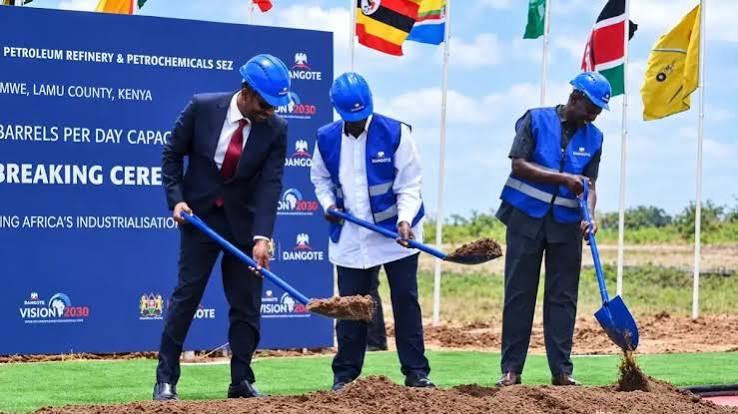
Aliko Dangote and President William Ruto broke ground on a $16 billion refinery and petrochemicals complex in Lamu on September 30, 2026, a project designed to process 700,000 barrels of crude a day. Dangote said the plant would be delivered within 40 months. The facility is central to Kenya’s wider industrial push, anchoring a planned industrial zone around Lamu.
The project, officially the Dangote East Africa Petroleum Refinery and Petrochemicals Special Economic Zone, is backed by Dangote Industries and the Africa Finance Corporation, with Engineers India Limited as a partner. The refinery is designed to serve Kenya and the wider Eastern African region. Its capacity matches that of the Dangote refinery in Lagos, Nigeria.
The main aim is to reduce the region’s dependence on imported refined fuel. Officials have argued that domestic refining would lower fuel costs and save hard currency that East African countries now spend on imports. The plant’s petrochemicals and bitumen production would add to the range of products made in the country.
The cost has been revised. Reports at the groundbreaking put the project at $16 billion, down from an earlier estimate of $17 billion, which Dangote attributed partly to a shorter construction period and lessons from his Lagos refinery. The shilling equivalent varies between reports, from about Sh2 trillion to about Sh2.2 trillion, depending on the exchange rate used.
Timing is also a key feature. Dangote has pledged to commission the refinery within 40 months, although independent estimates for construction range from 30 months to four years. The project will remain at the development stage for several years, even though the Lagos refinery already operates at commercial scale.
The government has said it will take a stake. Reports say Kenya plans to invest in the refinery through the National Infrastructure Fund, and that the project is intended to anchor a wider complex in Lamu. That complex would include power generation, petrochemicals, manufacturing, logistics and engineering services.
Dangote has also asked the government to protect the refinery from cheap imported fuel, a request that will shape how the plant competes once it begins operating. Local-content commitments include jobs for qualified Lamu graduates, a point that will matter for residents who have watched large projects in the region slip before.
Lamu is also being positioned as a broader industrial hub. The government is finalising plans for a Sh12.9 billion palm oil processing plant at Witu Nyangoro Ranch, and the refinery project includes a planned power plant of 435 megawatts. Those projects, if completed, would give the area a larger industrial base than it has today.
The President has framed the project as part of a wider rise in investment. Speaking at the groundbreaking, Ruto said Kenya had attracted a record US$3.2 billion in foreign direct investment, and that the refinery showed investor confidence. He said: “Today we turn a proposal into an industry.”
The project also faces tests on environmental and social grounds. Analysts have noted that the refinery will have to balance energy security, regional industrialisation, local employment and environmental safeguards. How the project handles those issues will shape its acceptance in Lamu and beyond.
The next signals will be construction milestones, the arrival of equipment and the terms of the government’s stake through the National Infrastructure Fund. Residents and investors will also watch whether local hiring and industrial spin-offs begin as the project moves from groundbreaking to construction.