Kenya's first confirmed case of Ebola this year has raised concerns over cross-border disease surveillance after a 40-year-old businessman travelled through the Democratic Republic of Congo (DR Congo) and Uganda before the infection was detected in Nairobi.
The businessman, who had lived in DR Congo for seven years, died on October 5, two days after being admitted to Nairobi Hospital in critical condition.
Laboratory tests confirmed that he had contracted the Bundibugyo strain of Ebola, the same strain responsible for the outbreak in DR Congo.
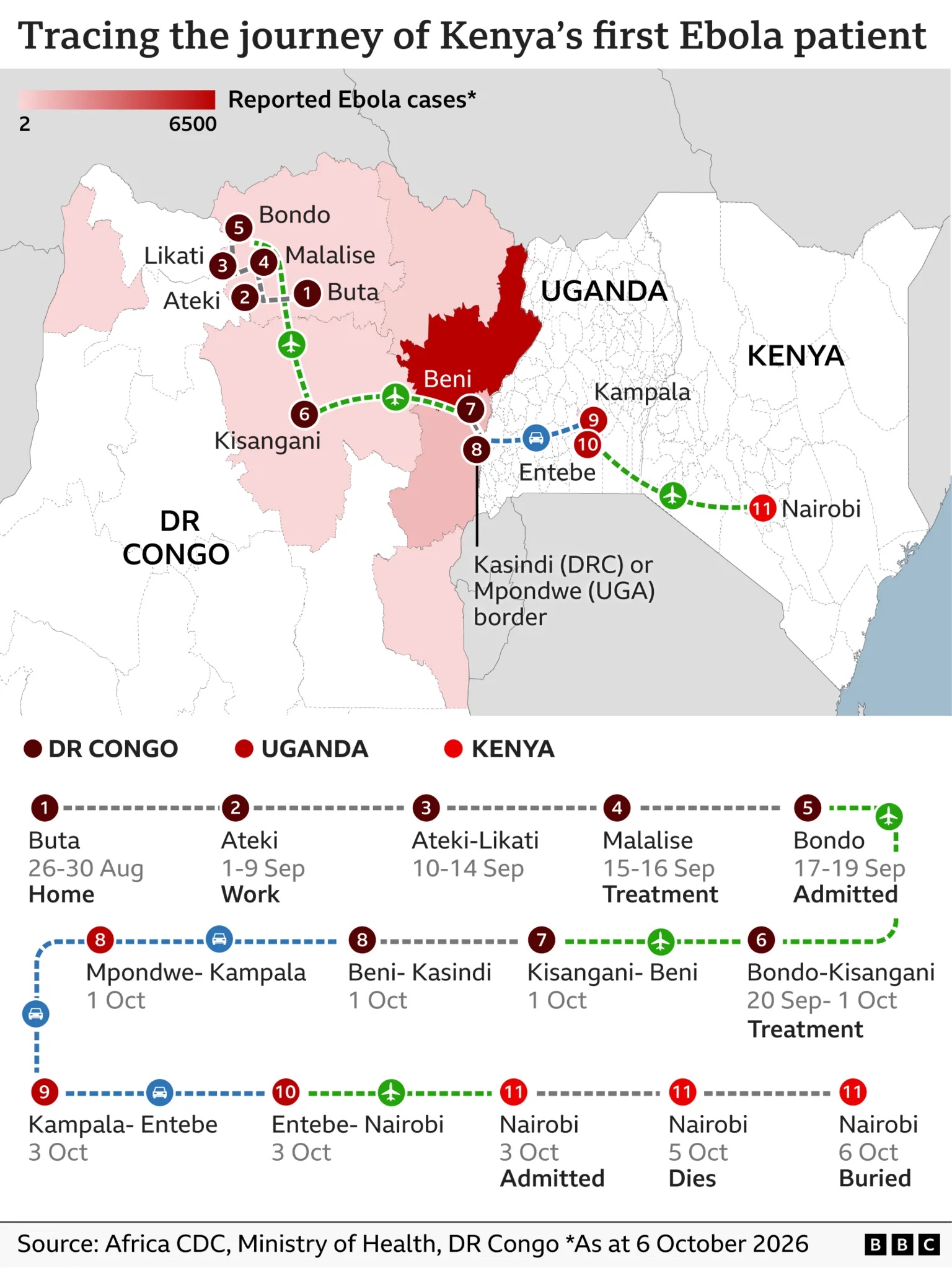
An investigation by the Africa Centres for Disease Control and Prevention (Africa CDC) has reconstructed the man's movements over nearly six weeks, revealing several opportunities at which his infection could potentially have been detected.
According to Africa CDC emergency director Dr Wessam Mankoula, the man travelled across three provinces in DR Congo while seeking medical treatment as his condition deteriorated.
However, he was not tested for Ebola during his visits to health facilities.
The man's symptoms reportedly began around September 15, when he developed an illness for which he was prescribed antibiotics and sent home.
Two days later, he was admitted to Tongo Etandi Health Centre in Bondo with fever and a rash but was diagnosed with a skin infection.
He subsequently travelled to Kisangani, the capital of Tshopo province, where he spent more than 10 days seeking medical attention.
On October 1, he travelled to Beni in North Kivu province before proceeding to Kasindi, a busy border town near Uganda.
The businessman crossed into Uganda later that day and travelled by road to Kampala before proceeding to Entebbe International Airport.
He boarded a flight to Nairobi on October 3.
Ugandan authorities said his temperature was normal when he underwent airport screening before departure.
He was also not flagged for further assessment upon arrival at Nairobi's Jomo Kenyatta International Airport.
Health experts say the case highlights the limitations of relying on temperature checks and passenger declarations to identify infectious diseases, particularly when symptoms fluctuate or medication may affect their presentation.
After arriving in Nairobi, the man was collected by a relative and driven directly to Nairobi Hospital, where his condition had worsened.
He was experiencing fever, chills, muscle pain, a sore throat and bleeding.
He was isolated after the infection was confirmed but died on October 5.
His burial was conducted under strict infection-prevention protocols.
Kenya's Ministry of Health says 66 people who may have come into contact with the patient have been identified, with the number expected to increase as contact-tracing efforts continue in Kenya, Uganda and DR Congo.
The ministry has also reported that more than 652,000 travellers have been screened and nearly 5,000 healthcare workers trained to respond to Ebola.
Five facilities have been designated to manage suspected or confirmed cases.
The outbreak in DR Congo has placed additional pressure on regional health systems, with North Kivu among the areas heavily affected by the disease.
However, investigators have not established precisely where or when the Kenyan businessman contracted the virus.
Ebola spreads through direct contact with the bodily fluids of an infected person who has developed symptoms or through contaminated materials.
Its incubation period ranges from two to 21 days, making early identification and monitoring of contacts essential.
Dr Mankoula has urged anyone experiencing symptoms consistent with Ebola to seek medical attention promptly and disclose their travel history to health workers.
The World Health Organization has also warned that fear, stigma and misinformation can discourage patients from reporting symptoms or seeking treatment.
In parts of DR Congo, health workers have faced hostility from people who deny the existence of the disease.
The case has renewed calls for stronger surveillance, information-sharing and coordination among neighbouring countries to prevent infected travellers from moving undetected across borders during major outbreaks.