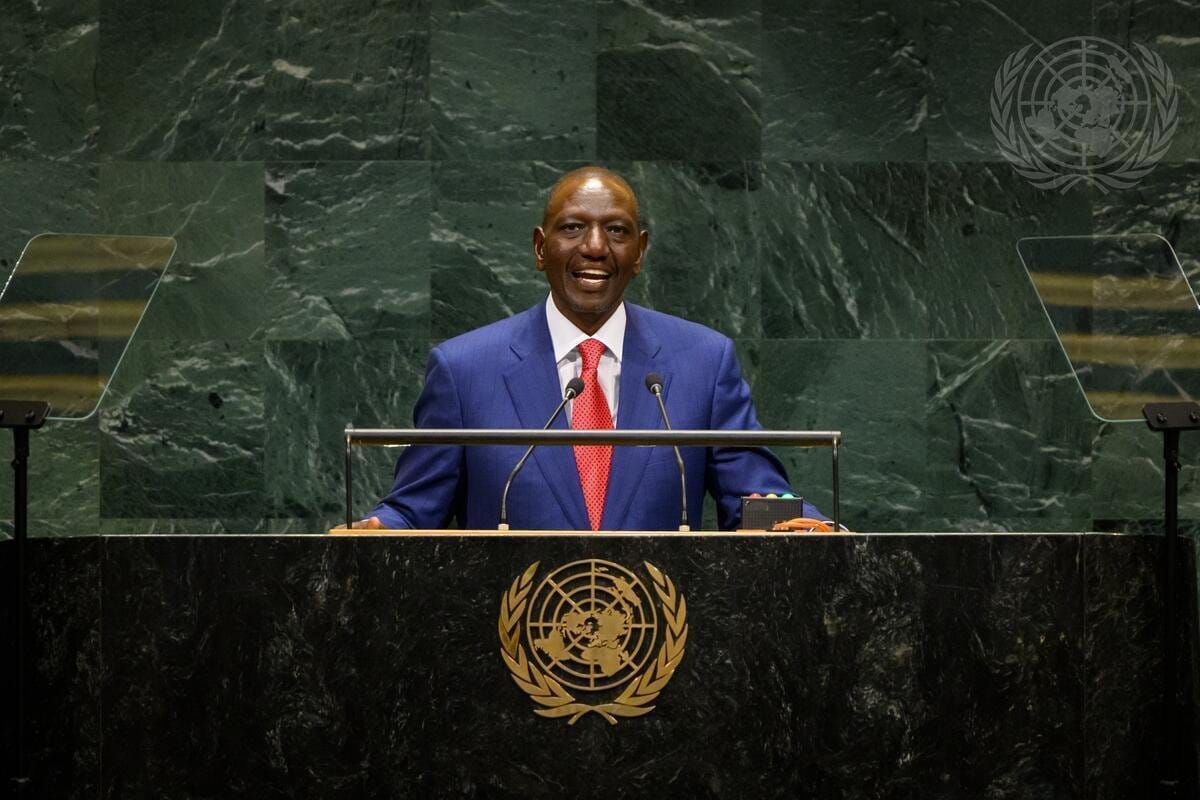
President William Ruto has called for sweeping reforms of the United Nations and the international financial system, arguing that institutions created more than eight decades ago no longer reflect today’s global realities.
Addressing the 81st United Nations General Assembly in New York on Wednesday, Ruto said Africa must have a greater voice in decisions on global peace, security and finance.
He criticised the composition of the UN Security Council, noting that Africa has 54 member states but no permanent seat on the council.
Ruto said the imbalance undermines the principle of sovereign equality and called for reforms that would give Africa equitable and permanent representation, including the privileges of permanent membership.
He also raised concerns over what he described as the inconsistent application of international law, warning that perceived double standards are weakening trust in the multilateral system.
The President also turned his attention to the global financial system, highlighting the debt burden facing developing countries.
Citing global public debt of 102 trillion dollars in 2024, Ruto said developing countries paid about one trillion dollars in interest that year, despite accounting for less than a third of the debt.
He said 46 developing countries now spend more on interest than on either health or education, and called for reforms to make development financing more affordable.
He proposed greater access to long-term and local-currency financing, as well as stronger risk-sharing mechanisms.
Ruto also criticised the cost of borrowing faced by African countries, arguing that sovereign credit ratings can make financing significantly more expensive for the continent.
The President said Africa must move beyond exporting raw materials and instead develop industries that add value to its resources.
He pointed to the continent’s mineral wealth, agricultural potential, renewable energy resources and young population as assets that could contribute to global food security, clean energy and resilient supply chains.
Ruto said Kenya intends to be part of that transformation, announcing that groundbreaking is expected within a week for an oil refinery in Lamu, which he said will have a capacity of 700,000 barrels per day and attract an estimated 16-billion-dollar investment.
He also highlighted Kenya’s investment in education, saying the government has spent an additional 5.3 billion dollars over the past four years.
According to Ruto, the investment has supported the recruitment of 100,000 teachers, the construction of more than 23,000 classrooms and the development of 1,600 laboratories, alongside increased support for universities and technical institutions.
Ruto concluded by urging countries to reform global institutions rather than wait for another major crisis.
He said Kenya wants a United Nations in which every nation has a voice, every people has a stake and every child has a future.