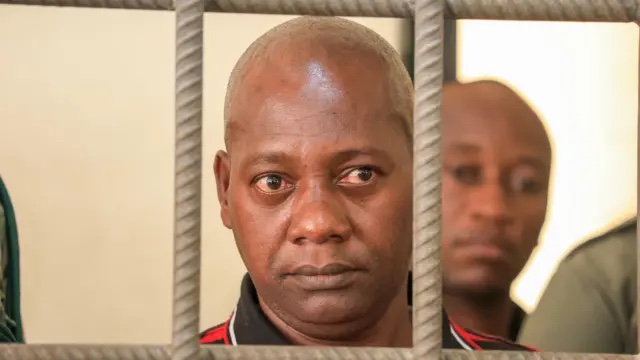
A High Court in Mombasa has sentenced controversial preacher Paul Mackenzie to 200 years in prison following his conviction on multiple counts of murder linked to the Shakahola massacre, one of Kenya’s deadliest cases involving religious extremism.
Justice Diana Kavedza delivered the sentence, imposing a 100-year prison term on each of the 103 counts of murder by starvation, involving one adult and 102 children. The sentences will run concurrently.
The court further sentenced Mackenzie to 100 years for each of the eight counts of murder through direct killing involving child victims. These sentences will also run concurrently.
However, Justice Kavedza ordered the two sets of sentences to run consecutively, bringing Mackenzie’s total prison term to 200 years.
Two other accused persons, Smart Deri Mwakalama and Stephen Sangamuya, were also sentenced in the same proceedings.
Both received eight-year prison terms on the 103 counts of murder by starvation, with the sentences running concurrently.
They were also handed eight years on each of the eight counts of murder by direct killing, with the sentences in that category also running concurrently.
The two sets of sentences were ordered to run consecutively.
A third accused person, identified in the proceedings as Stephen Sanga Muya, was sentenced to eight years in prison on each of the 183 counts of murder by starvation, involving one adult and 182 children.
The sentences were ordered to run concurrently.
The court also handed varying sentences to the other 25 convicts involved in the case.
In a significant part of her ruling, Justice Kavedza declined to impose the death penalty on the convicts, despite acknowledging the extraordinary gravity of the crimes and noting that they met the threshold for capital punishment.
The judge observed that the Shakahola killings represented an exceptional case in Kenya’s criminal history, given the scale of the deaths and the vulnerability of the victims.
“Indeed, if any case in the history of this country approaches that threshold, this is it.
Nevertheless, the court declines the invitation to impose the death penalty on any of the victims,” Justice Kavedza stated.
She clarified that the decision should not be interpreted as the court taking a position on the broader debate surrounding the constitutionality or desirability of capital punishment, noting that the issue fell outside the scope of the proceedings.
The Shakahola massacre involved followers of Mackenzie, who allegedly subjected themselves and their children to extreme religious teachings centred on fasting in anticipation of meeting Jesus Christ.
The discovery of mass graves and numerous bodies in Shakahola Forest, Kilifi County, in 2023 shocked the country and triggered investigations into the activities of Mackenzie’s Good News International Church.
The case exposed the dangers of religious extremism and raised serious questions about the regulation of religious institutions and the protection of vulnerable followers, particularly children.