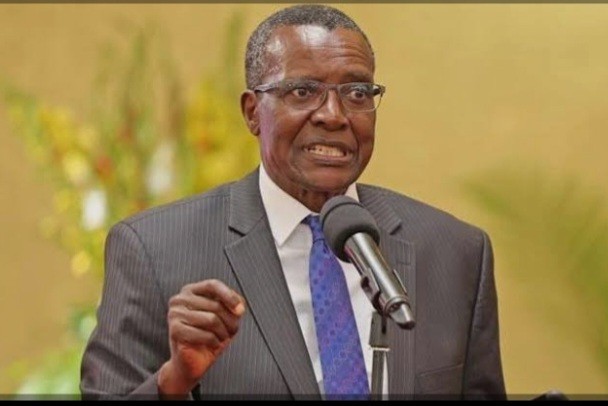
Chief Justice Emeritus David Maraga has called for the immediate and unconditional acquittal of Tanzanian opposition leader Tundu Lissu, accusing the government of using treason charges to suppress political dissent and silence calls for democratic reforms.
In a statement issued on October 6, 2026, under the United Green Movement (UGM) Party, Maraga dismissed the treason case against Lissu as legally unfounded, arguing that political opposition and demands for constitutional reforms should not be treated as attempts to overthrow a government.
Maraga, who is UGM's co-party leader and its 2027 presidential candidate, said treason requires proof of a deliberate intention to overthrow a government through unlawful and violent means.
He maintained that peaceful demonstrations, political criticism and calls for an electoral boycott to push for constitutional changes do not meet the legal threshold for treason.
He further argued that the evidence presented in court had failed to establish the required standard of proof beyond reasonable doubt, urging the judiciary to uphold the rule of law and acquit Lissu.
The former Chief Justice also expressed condolences to Lissu following the death of his elder brother, saying the opposition leader was facing a difficult legal battle while mourning his family loss. He extended his solidarity to Lissu's family, the CHADEMA party and other pro-democracy groups across East Africa.
Maraga also criticised what he described as a growing pattern in Kenya, Tanzania and Uganda, where treason and terrorism charges were being used against opposition figures.
He accused Tanzania's ruling Chama Cha Mapinduzi (CCM), under President Samia Suluhu Hassan, of departing from the democratic principles associated with its founding leader, Julius Nyerere.
According to Maraga, Nyerere envisioned an East African Community built on shared values, democratic leadership and credible elections, rather than political repression.
He further condemned reports of killings, abductions and torture of young protesters in Tanzania, particularly those who participated in demonstrations against the government.
Maraga accused the Kenyan and Tanzanian governments of allowing a cycle of violence in which civilians were allegedly killed, abducted or tortured before their families were offered financial compensation.
He also raised concerns over alleged cross-border abductions targeting political activists within the region, warning that Kenya was increasingly becoming a platform for operations against individuals from neighbouring countries.
He cited the reported disappearance of Tanzanian activists on Kenyan soil and the cross-border seizure of Ugandan opposition leader Dr Kizza Besigye as examples of actions that undermine regional cooperation and established legal procedures.
Maraga argued that such operations violate international human rights protections, including Article 5 of the African Charter on Human and Peoples' Rights and provisions of the East African Community Treaty.
Turning to Tanzania's political future, Maraga called on President Samia to engage opposition leaders in pushing for a new Constitution that reflects the wishes of citizens.
He said Tanzanians had a legitimate right to demand constitutional reforms, adding that the country should learn from Kenya's 2007-2008 post-election violence and resolve political disagreements through dialogue and institutional reforms.
The statement also referenced Tanzania's Constitutional Review Commission established between 2012 and 2014 and the 2023 Criminal Justice Reform Commission as part of previous efforts to address governance and justice concerns.
Maraga further cited findings attributed to the Presidential Commission of Inquiry into violence during and after Tanzania's October 2025 General Election, chaired by former Chief Justice Mohamed Chande Othman.
According to the figures cited in the statement, at least 518 people died from unnatural causes, including 197 who were reportedly shot dead. More than 2,300 people were injured, while 758 others were reported missing.
He also warned foreign governments and international development partners against supporting regimes accused of using surveillance technology and security equipment to target political opponents and civilians.
Maraga maintained that countries providing funding, training and technological support for operations involving alleged abductions, torture and killings should be held accountable.
He concluded by reaffirming his solidarity with Lissu and calling for greater democratic accountability, constitutionalism and respect for human rights across East Africa, insisting that the push for political change, commonly referred to as Mageuzi, could not be stopped.