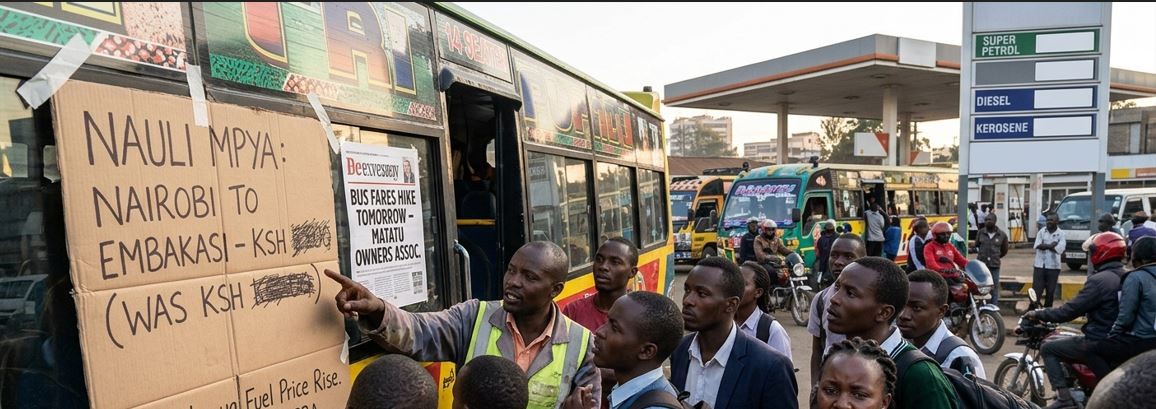
The Motorists Association of Kenya (MAK) has condemned the latest fuel price increases announced by the Energy and Petroleum Regulatory Authority (EPRA), demanding an independent review of the pricing calculations and greater transparency in petroleum importation.
In its statement, MAK criticised the new prices, which took effect at midnight on October 15 and will remain in force until November 14, 2026, warning that the increases would place additional pressure on motorists, transport operators and households already struggling with the high cost of living.
Under the revised prices, a litre of Super Petrol in Nairobi now retails at KSh226.96, Diesel at KSh227.76 and Kerosene at KSh219.87.
The prices represent increases of KSh12.93 for Super Petrol, KSh9.90 for Diesel and KSh28.49 for Kerosene.
The Association questioned the sharp increase in kerosene prices, arguing that the product recorded a lower percentage increase in landed costs than petrol and diesel but experienced the highest percentage increase at the pump.
According to figures cited by MAK from EPRA's reported landed costs, Super Petrol recorded an 11.81 per cent increase in landed costs, while Diesel rose by 11.32 per cent. Kerosene's landed cost increased by 9.41 per cent.
However, the corresponding pump prices increased by 6.04 per cent for Super Petrol, 4.54 per cent for Diesel and 14.89 per cent for Kerosene.
MAK said the differences warranted a detailed explanation from EPRA, including a breakdown of freight charges, insurance, exchange rates, taxes, levies, commercial margins and stabilisation adjustments used to calculate the final prices.
The association also questioned the reported explanation that the kerosene price adjustment was partly intended to narrow the price difference between kerosene and automotive fuels to discourage fuel adulteration.
It argued that authorities should strengthen surveillance, fuel quality testing and enforcement against dealers involved in adulteration instead of transferring the burden to households that depend on kerosene for cooking and lighting.
The association further called for an independent audit of the Government-to-Government (G-to-G) petroleum importation arrangement, which was introduced to help ease foreign exchange pressures and stabilise fuel supplies.
MAK said the government should publish verifiable figures showing the arrangement's financial benefits to consumers, including supplier premiums, financing costs, freight charges and foreign exchange exposure.
The Association also raised concerns about how changes in international petroleum prices are reflected in local pump prices, calling on EPRA to publish historical comparisons of international benchmarks, actual landed costs and domestic retail prices.
MAK maintained that the monthly pricing formula and any stabilisation adjustments should be explained in a manner that allows independent scrutiny.
The Association warned that the latest increases would have a ripple effect across the economy, particularly in road freight and public transport.
It illustrated the impact using a heavy commercial vehicle consuming 400 litres of Diesel on a journey. The latest increase of KSh9.90 per litre would add KSh3,960 to its fuel bill.
For a fleet of 20 vehicles making comparable journeys, the additional expenditure would amount to KSh79,200.
The association cautioned that transport operators could struggle to absorb the additional costs, potentially leading to higher fares and freight charges, which could push up the prices of food and other essential commodities.
Among its demands, MAK called for an independent review of the October-November pricing cycle, publication of detailed pricing worksheets, an audit of the G-to-G arrangement and greater disclosure of the Petroleum Development Levy Fund's receipts and expenditure.
It also urged Parliament, the Auditor-General and the Competition Authority of Kenya to scrutinise petroleum procurement and pricing arrangements.
The Association said it would consult its members and other stakeholders on possible peaceful demonstrations and coordinated public mobilisation if its concerns remained unanswered.
MAK clarified that it was not demanding free fuel but fair pricing, transparent calculations and greater competition in petroleum procurement.