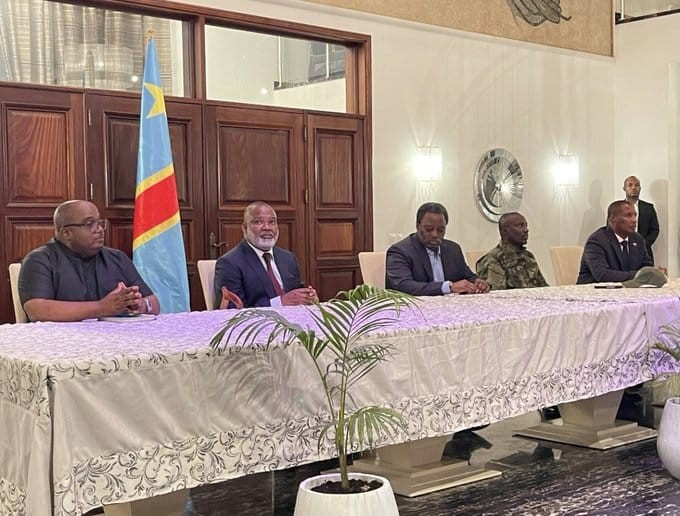
Former Democratic Republic of Congo (DRC) President Joseph Kabila has been named leader of a new politico-military movement, the Front for the Refoundation of the Nation (FRN), launched in Goma on Monday, October 12.
The new movement brings together key figures associated with the Alliance Fleuve Congo (AFC) and the March 23 Movement (M23) rebel group, marking a major restructuring of the forces opposing President Félix Tshisekedi’s government.
According to the announcement, Kabila will be supported by Bertrand Bisimwa and Corneille Nangaa as vice-presidents. Major General Sultani Makenga, a senior M23 military figure, has been designated chief of staff of the Congolese Revolutionary Army (ARC), with the rank of vice-president.
The formation of the FRN follows a meeting in Goma, the eastern Congolese city that has been under M23 control since January 2025.
The movement’s establishment marks the end of the AFC as a separate organisation, with the new front presented as its successor. However, the announcement does not independently establish that the M23 has ceased to exist as a distinct armed group.
FRN adviser Claude Ibalanky said the coalition intends to unite and coordinate resistance forces to challenge the current government.
At its launch, the movement outlined its intention to end what it described as tyranny, including through the use of force, and to establish a new political direction for the country.
The announcement comes amid an ongoing conflict in eastern DRC, where M23 fighters have seized significant territory and fighting has complicated regional peace efforts.
Kabila, who served as president from 2001 to 2019, has faced accusations from Congolese authorities of supporting the AFC-M23 movement. He has previously denied involvement in the insurgency.
His emergence as leader of the new coalition marks a more direct political role in the opposition movement, which includes figures linked to the armed rebellion in the country's east.
The development also comes as diplomatic efforts continue to address the conflict and tensions between Kinshasa and Kigali, which the Congolese government has accused of backing M23. Rwanda has denied supporting the rebel group.
The FRN’s formation introduces a new structure for the forces opposing Tshisekedi’s administration, although its next steps and the implications for ongoing peace initiatives remain uncertain.