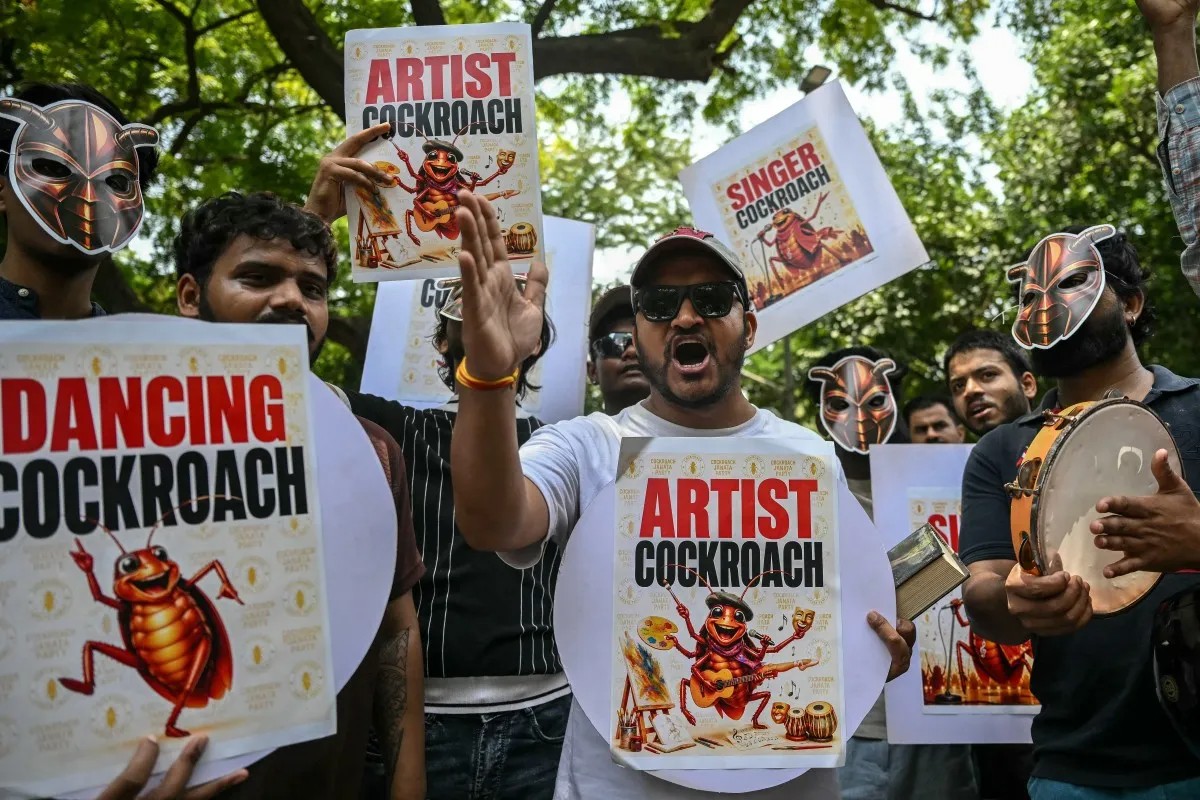
Thousands of young protesters in India are expected to return to the streets of New Delhi on Friday to demand electoral reforms, days after police blocked their previous mass demonstration and jailed two of their leaders.
The Cockroach Janta Party (CJP), a youth-led movement challenging alleged electoral irregularities, has called on supporters to gather at Central Park in Connaught Place, a busy commercial district in the Indian capital.
The planned demonstration follows the jailing of two CJP leaders for five days after they entered Jantar Mantar, a designated protest site that police had recently declared off-limits.
Background of the protests
What began as a campaign against alleged electoral fraud has since evolved into a broader dispute over the right to protest peacefully.
The Delhi High Court on Thursday declined to issue an order preventing the demonstration after a local trader filed a petition arguing that the gathering could disrupt traffic and business activities.
Central Park is also not an officially approved protest venue.
CJP founder Abhijeet Dipke has named Friday’s demonstration *Lehra Do Tiranga*, meaning “Wave the Tricolour”, in reference to India’s national flag.
Dipke has said he is prepared to risk arrest as the movement presses ahead with its demands.
However, police barricades and the possibility of mass detentions could prevent many demonstrators from reaching the gathering point.
During last Saturday’s attempted protest, security officers blocked roads, restricted access to protest areas and detained organisers before crowds could assemble.
Dipke has urged supporters unable to travel to Delhi to display the Indian flag and demonstrate wherever they are.
The CJP movement emerged in May after India’s chief justice reportedly compared some unemployed young people to cockroaches.
Dipke embraced the label and transformed it into a youth-led online campaign that later grew into street demonstrations.
By July, the movement had attracted significant attention through protests over alleged examination paper leaks, putting pressure on the government over concerns about the education system.
The movement has since broadened its campaign to challenge the government of Prime Minister Narendra Modi, with electoral integrity now at the centre of its demands.
Demands for electoral reform
The protesters oppose a nationwide revision of electoral rolls known as the Special Intensive Revision (SIR).
Critics claim the exercise has removed more than 130 million names from voter lists, raising concerns that eligible citizens could lose their right to vote.
The CJP has demanded the resignation of Chief Election Commissioner Gyanesh Kumar, accusing the Election Commission of favouring Modi’s ruling Bharatiya Janata Party (BJP).
Both the government and the electoral body have denied allegations of wrongdoing.
The demonstrations are unfolding alongside a separate campaign by India’s opposition parties, which have also accused the Election Commission of manipulating voter lists to benefit the BJP.
Last week, opposition leader Rahul Gandhi and other lawmakers attempted to march to the commission’s headquarters in New Delhi but were stopped by police and detained.
Opposition politicians have since taken their grievances to President Droupadi Murmu and staged further demonstrations, including a march towards the Supreme Court.
Among the prominent figures involved in the protests is Neha Bora, a leader of the left-wing All India Students’ Association (AISA).
Bora was detained while leading demonstrators last Saturday and later joined Gandhi and his sister, Priyanka Gandhi Vadra, at a march.
Although the CJP, student organisations and opposition parties have largely organised separate demonstrations, their demands have increasingly converged around electoral transparency and the right to protest.
Convergence of protest movements
Gandhi has condemned the arrests of CJP organisers and called for Jantar Mantar to be reopened to peaceful demonstrators.
Home Minister Amit Shah, however, has accused opposition parties of spreading misinformation about the voter-verification exercise and defended the independence of the Election Commission.
Friday’s planned demonstration is expected to test the authorities’ handling of public protests as pressure mounts for greater transparency in electoral processes.
It also highlights growing tensions between youth-led movements, opposition parties and the government over voting rights, institutional accountability and freedom of assembly.