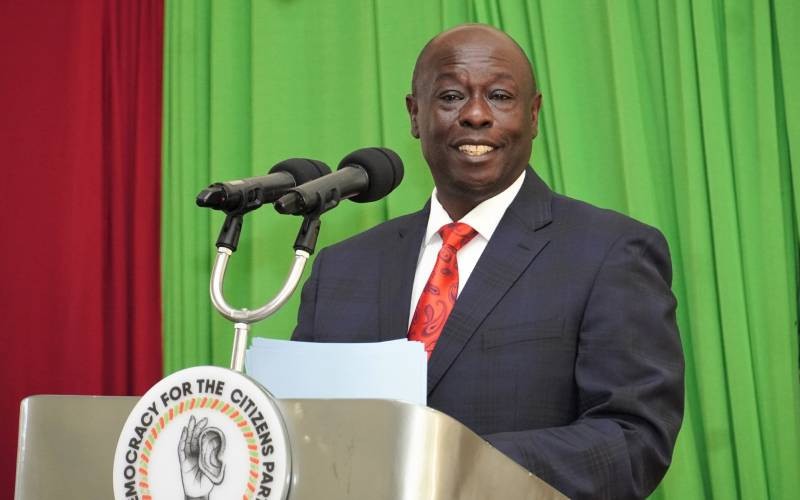
Democracy for the Citizens Party (DCP) leader Rigathi Gachagua has welcomed the Independent Electoral and Boundaries Commission’s (IEBC) decision to invite opposition leaders for a consultative meeting, describing the move as a positive step towards addressing concerns surrounding the electoral process.
However, the former Deputy President has urged the commission to give opposition leaders more time to present their grievances, arguing that adequate consultations are necessary to address the issues raised by political parties.
Speaking during a meeting with a delegation from Kiharu Constituency at his Wamunyoro residence, Gachagua said the IEBC should provide an opportunity for opposition principals to comprehensively outline their concerns before any decisions are made.
Concerns over electoral process
He also called on the Registrar of Persons to hold separate consultations with opposition leaders over what he described as bias in the issuance of national identity cards.
Gachagua alleged that the process of issuing identification documents was not being conducted fairly, raising concerns about the possible exclusion of eligible Kenyans from accessing essential government services and participating in electoral processes.
He warned that failure to address the complaints could trigger protests, threatening to mobilise Generation Z activists to occupy the Registrar of Persons' offices in a bid to force action on the matter.
The DCP leader also dismissed claims that he was responsible for divisions within the opposition, following the release of TIFA Research opinion polls suggesting that his political influence could be contributing to disagreements among opposition figures.
Instead, Gachagua portrayed himself as a central figure in efforts to unite opposition leaders, describing himself as the "glue" holding the political formation together.
He maintained that his involvement in opposition politics was aimed at building a stronger political movement capable of challenging President William Ruto's administration.
The former Deputy President also turned his criticism towards President Ruto's "Usawa ni Sawa" slogan, accusing the Head of State of using the messaging in a manner that could deepen ethnic divisions in the country.
Criticism of President Ruto
Gachagua linked the slogan to the painful memories of the 2007-2008 post-election violence and the controversial "41 versus 1" narrative, which became associated with ethnic tensions in Kenya's political landscape.
He accused the President of reviving divisive political rhetoric and creating an atmosphere that could turn Kenyans against a particular community.
His remarks come amid growing political contestation between the government and opposition leaders, with questions surrounding electoral preparedness, national identification processes and political alliances increasingly dominating public debate.
Political contestation in Kenya
Gachagua further challenged President Ruto over the choice of his running mate in the next General Election, insisting that the outcome of the presidential contest had already been determined in the minds of voters.
He declared that Kenyans had already made up their minds to vote the President out, arguing that the decision would not change regardless of whom Ruto selects as his deputy.
The remarks signal Gachagua's continued efforts to position himself as a leading opposition figure as political realignments and preparations for the next General Election gather momentum.