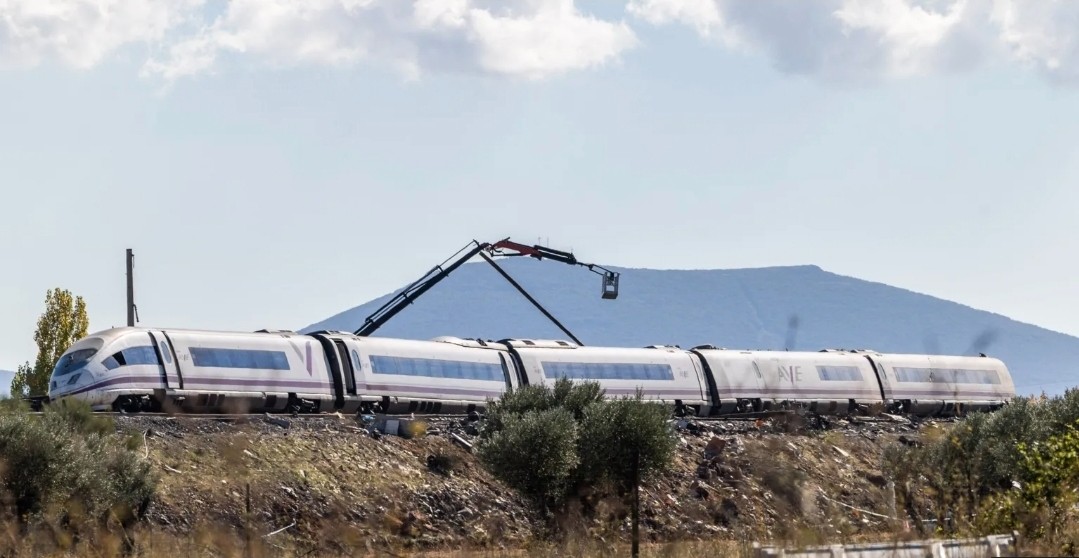
European Union prosecutors have launched an investigation into the possible misuse of EU funds allocated for upgrading Spain's railway infrastructure, following two deadly train accidents that have claimed 115 lives in less than a year.
The European Public Prosecutor's Office (EPPO) confirmed on Friday that investigative activities were underway at the offices of Spain's rail infrastructure authority, Adif, and the country's rail safety agency, AESF.
The investigation centres on possible fraud involving European Union funds allocated for the renovation and improvement of railway safety, signalling and communication systems along the Madrid-Seville high-speed railway line.
In a statement, the EPPO said the investigation was being conducted with the support of a specialised unit of Spain's Guardia Civil security force.
The prosecutors, however, declined to provide further details, citing the public interest surrounding the case.
The inquiry follows the October 28 train disaster near the village of Urda, approximately 130 kilometres south of Madrid, in which 69 people were killed after a train operated by state-owned Renfe crashed into the rear of a stationary train belonging to private operator Iryo.
Preliminary information indicated that the LZB communication system, which monitors train positions and movement along the railway, had failed.
The Renfe train had reportedly been cleared to resume travelling at normal speed despite the Iryo train ahead being unable to restart, resulting in the deadly collision.
The latest investigation is the second EU fraud inquiry involving Spain's railway network this year.
In January, another train accident along the same Madrid-Seville line at Adamuz killed 46 people, raising fresh questions about railway safety and infrastructure maintenance.
The two disasters, occurring nine months apart, have left 115 people dead and dozens injured.
The European Public Prosecutor's Office said the investigation would examine whether EU funds intended to improve railway safety and communications infrastructure were properly utilised.
Under the investigation, a Spanish judge assigned to the case will oversee compliance with legal safeguards, including authorising investigative measures such as searches and telephone surveillance where necessary.
The latest development has increased pressure on Prime Minister Pedro Sánchez's Socialist-led government ahead of parliamentary elections scheduled for November 29.
Transport Minister Óscar Puente, a close ally of Sánchez, resigned earlier this week following criticism over the two deadly railway accidents that occurred during his tenure.
However, the conservative People's Party (PP) and far-right Vox have rejected his resignation as insufficient, demanding that the Prime Minister also take political responsibility.
The disasters have also shaken public confidence in Spain's high-speed railway network, with reports of widespread train cancellations and increasingly empty station platforms as passengers reconsider rail travel.
A memorial service for the 69 victims of the Urda disaster is scheduled for Tuesday at Toledo Cathedral, in the province where the crash occurred.
Puente's successor, Carlos Cuerpo, has pledged to take all necessary measures to restore public confidence in Spain's high-speed railway system.
On Friday, Cuerpo met survivors of the January Adamuz disaster, who presented him with a list of 11 demands aimed at strengthening railway safety and preventing similar tragedies.
The EU investigation is expected to examine whether shortcomings in the management or use of European funding contributed to weaknesses in the railway infrastructure.
However, no findings of financial wrongdoing have yet been established.