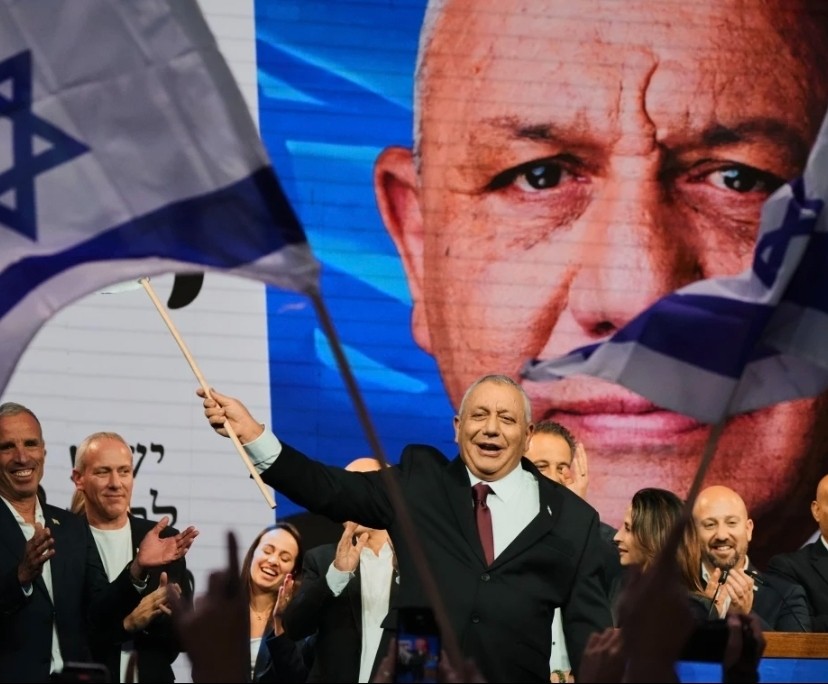
Israeli opposition leader Gadi Eisenkot has been given the first opportunity to form a new government following last month's parliamentary elections, placing Prime Minister Benjamin Netanyahu's long-standing leadership at risk.
President Isaac Herzog announced on Saturday night that he had tasked Eisenkot, a former military chief and the main challenger to Netanyahu, with assembling a governing coalition after the October 27 elections.
The decision marks a significant political development in Israel, where Netanyahu and his allies lost their parliamentary majority, paving the way for a possible change of government after years in power.
Eisenkot, who leads the Yashar party, now has up to six weeks to negotiate with other political formations and secure the parliamentary numbers required to establish a government.
Reacting to the announcement, Eisenkot called for the formation of a national emergency government, pledging to work towards bringing together different political interests.
"This is the time to establish a national emergency government. I will do anything possible to prove us worthy," he wrote in a post on his X account shortly after Herzog's announcement.
During consultations with the president earlier in the week, representatives from most of Israel's major political parties recommended that Eisenkot be given the mandate to form the next administration.
However, the task ahead is expected to be difficult, with neither Netanyahu's political bloc nor Eisenkot's alliance securing an outright parliamentary majority.
The outcome has placed Arab-led political parties in a potentially decisive position, following historic gains in the elections. Their support could provide the numbers needed for Eisenkot to secure power, although any formal cooperation is likely to generate significant political controversy.
An Arab party has previously participated in an Israeli governing coalition only once in the country's history, making the prospect of another such arrangement particularly sensitive.
The political debate is unfolding against the backdrop of more than three years of conflict following the October 7, 2023, Hamas-led attacks on Israel, which triggered a devastating military campaign in Gaza and subsequent hostilities across the region.
Netanyahu has strongly opposed the possibility of Eisenkot forming an alliance with Arab-led parties, repeatedly portraying them as a threat to Israel's national security.
In a video statement released shortly before Herzog announced his decision, Netanyahu called for a national unity government and warned against what he described as the rushed formation of an administration supported by terrorist sympathisers.
His remarks appeared directed at Arab-led political formations, which he has accused of undermining Israel's security. However, his claims that these parties influenced the election outcome improperly have not been substantiated.
Eisenkot has indicated that he could work with Arab-led parties under certain conditions, including their acceptance of his position that Hamas is a terrorist organisation that must be destroyed.
One possible route would involve forming a broad-based unity government with major Jewish political parties, potentially including Netanyahu's Likud, which remains the single largest party in parliament.
However, significant disagreements between the two leaders could complicate such an arrangement.
Among the contentious issues are Netanyahu's reliance on religious parties that demand exemptions from compulsory military service for ultra-Orthodox men, as well as his opposition to establishing a formal inquiry into security failures surrounding the October 7 attacks.
Another option available to Eisenkot is the formation of a minority government, which would depend on external parliamentary support from Arab-led parties without necessarily including them as formal coalition partners.
However, some members of his political bloc have already indicated that they would reject such an arrangement, further narrowing his options.
Meanwhile, Eisenkot's Yashar party has criticised Netanyahu's appeal for national unity, urging members of Likud to reconsider their association with what it described as radical political parties within Netanyahu's religious-nationalist alliance.
The party maintained that any government formed under Eisenkot would only include political formations and lawmakers willing to subscribe to its guiding principles.
The coming weeks are therefore expected to determine whether Eisenkot can overcome the political divisions, secure sufficient parliamentary backing and bring an end to Netanyahu's tenure as Israel's longest-serving prime minister.