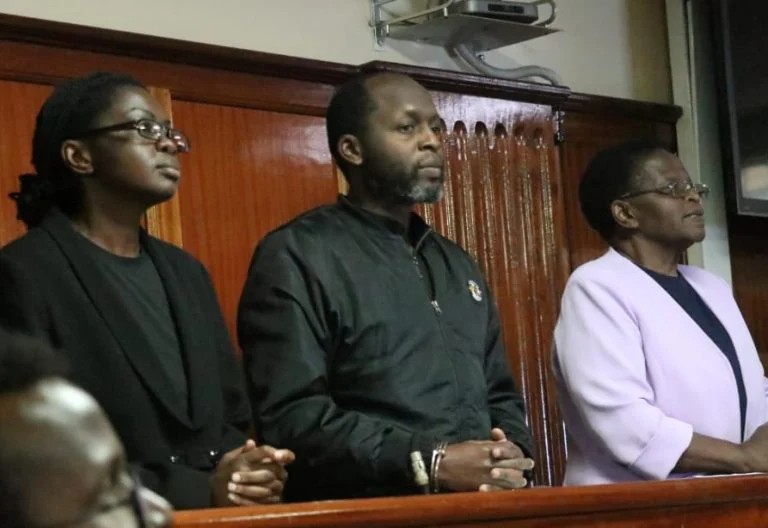
The three people accused of killing Dr. Victoria Mutiso have asked the court to allow them to cross-examine her ex-husband, Prof. David Ndetei, over an affidavit he allegedly swore opposing their release on bail.
The accused persons, Rose Mbithe Mulwa and her two children, Angela Mulwa and Chris Mulwa, have questioned the authenticity of the affidavit, arguing that Prof. Ndetei was reportedly admitted to a High Dependency Unit (HDU) when he is said to have sworn the document.
Through their lawyers, the three want the court to allow them to question the professor to establish whether he personally made and signed the affidavit.
Court proceedings overview
In the affidavit, Prof. Ndetei reportedly asked the court not to release his former wife and her two children on bail, saying he feared for his life.
He claimed that after divorcing Rose Mbithe Mulwa in 2001 and marrying Dr. Victoria Mutiso, he and his new wife continued to face threats from his estranged wife and her children.
The defence has challenged the circumstances surrounding the affidavit, saying the professor's reported hospital admission raises questions that should be addressed in court.
However, the prosecution, through lawyer Makori, opposed the application. The State argued that the defence had missed the appropriate stage to make the request.
The prosecution also argued that the defence could not dictate how the Independent Policing Oversight Authority (IPOA) should conduct its investigations, noting that the authority was not a party to the court proceedings.
The court is expected to rule on the application on the 19th.
Meanwhile, lawyers representing the three accused persons have renewed their plea for their release on lenient cash bail terms.
Defence arguments for bail
Defence counsel Mbaluka told the court that the accused were not flight risks and had not shown any intention of fleeing from justice.
The lawyer said the three lived in Karen and argued that the prosecution had not presented evidence showing they were likely to abscond if released.
The defence also raised concerns about the accused persons' health, claiming that they had medical conditions requiring specialised treatment. Some of the conditions, the lawyers alleged, developed or were worsened while the accused were in custody.
They urged the court to consider cash bail instead of bond, arguing that the right to bail is protected under Article 49(1)(h) of the Constitution.
“The rule is granting of bail; denial is the exception. The prosecution must prove compelling reasons accompanied by evidence,” the defence argued.
On the possibility of witness interference, the lawyers maintained that the prosecution had not provided sufficient evidence to show that the accused were likely to threaten or interfere with witnesses.
They argued that suspicion alone was not enough to justify continued detention and that the State needed to demonstrate a real risk of interference.
The defence further submitted that investigators had already secured the key evidence they said they had recovered, meaning it could be preserved and analysed without keeping the accused in custody.
Medical treatment requests
In a separate application, the defence asked the court to allow the three accused persons to receive treatment at Kenyatta National Hospital or Mbagathi Hospital.
However, the court directed that they first receive treatment at the prison clinic. It further ordered that if the officer in charge of the prison determined that they needed additional medical attention, they should be taken to a government health facility.
The court's upcoming ruling on the affidavit application will determine whether the defence will be allowed to question Prof. Ndetei over the disputed document.
The bail application remains a key issue in the case as the court considers the arguments presented by both the prosecution and the defence.