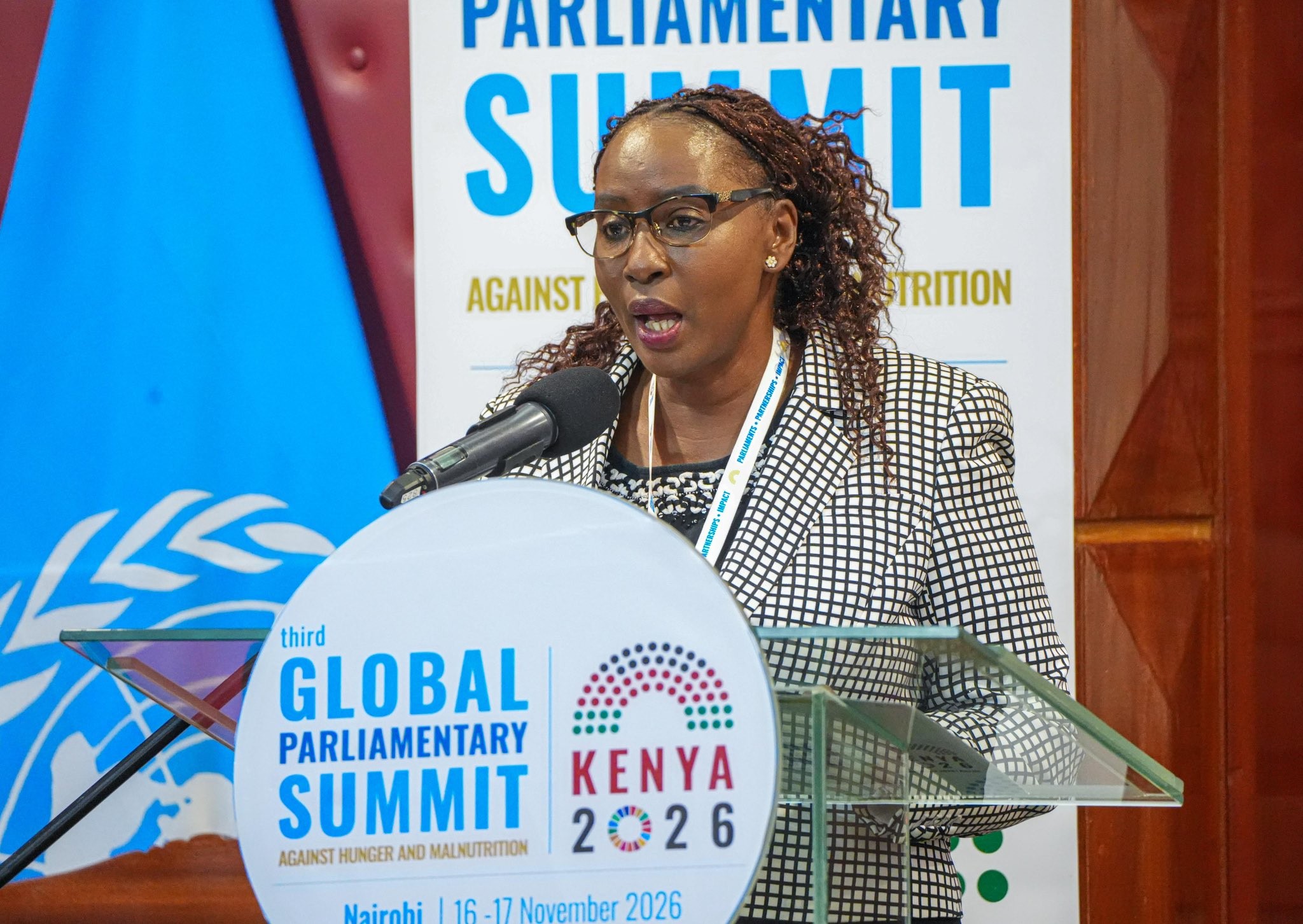
Dagoretti North Member of Parliament Beatrice Elachi has called on Parliament to enact legislation that guarantees sustainable funding for school feeding programmes, warning that millions of learners risk missing meals whenever government funding is disrupted.
Elachi said school feeding should not remain a programme dependent on annual budget allocations but should be protected by law to ensure children continue receiving meals regardless of changes in government priorities or funding decisions.
Speaking on Tuesday during the Third Global Parliamentary Summit Against Hunger and Malnutrition in Nairobi, the legislator highlighted the importance of school meals in fighting hunger, improving school attendance and supporting children's health and academic performance.
Importance of school feeding programmes
She argued that access to food is a key part of national development, noting that children cannot fully benefit from education when they attend school hungry.
“A nation is not truly developed when its economy grows, but when its citizens no longer go to bed hungry,” Elachi told delegates.
She also cited former Food and Agriculture Organization Director-General Lord John Boyd Orr, who observed that “You can't build peace on empty stomachs.”
Using Kenya's school feeding programme as an example, Elachi traced its history to 1980, when the government, working with the World Food Programme, began providing meals to approximately 240,000 learners.
The programme has since expanded significantly, reaching more than 1.5 million learners by August 2022. The government is now targeting to extend its coverage to 10 million children by 2030.
However, Elachi noted that despite the expansion, Kenya still lacks a specific law that guarantees every child access to a meal at school and provides for dedicated funding for the programme.
Legislative gaps in funding
She pointed to Articles 43 and 53 of the Constitution, which provide for the right to food of acceptable quality and every child's right to basic nutrition, alongside free and compulsory basic education.
According to the MP, while these constitutional provisions establish the foundation for supporting school feeding, the absence of a specific law leaves the programme exposed to funding uncertainties.
Elachi urged Parliament to address the gap by introducing legislation that would make school meals a guaranteed entitlement for learners rather than an initiative that depends on yearly government budget decisions.
She also highlighted Nairobi County's school feeding initiative, which brings together the county government, parents and development partners to provide meals to learners.
The programme currently serves approximately 316,000 learners and uses a digital payment and monitoring system that allows parents to track whether their children have received meals at school.
Elachi said the initiative has helped improve school enrolment and retention while supporting local farmers through food procurement arrangements with schools.
Despite the progress, she identified inadequate and unpredictable financing, logistical difficulties, limited food storage and safety facilities, and gaps in nutritional quality as some of the challenges affecting school feeding programmes.
Challenges facing school feeding
She called for stronger parliamentary oversight, regular monitoring and independent audits to ensure funds allocated to the programmes are properly used and learners receive nutritious meals.
The legislator further urged Parliament to ensure that legislation, funding and accountability measures are addressed together to protect the future of school feeding initiatives.
“Parliament's strongest contribution is to convert the programme from an annual budget decision into a statutory, funded, and measured entitlement. Legislation, appropriation, and oversight must move together,” she emphasised.
Her remarks come amid growing calls for stronger measures to address hunger and malnutrition, particularly among school-going children, with school feeding programmes viewed as an important tool in improving education and child welfare.