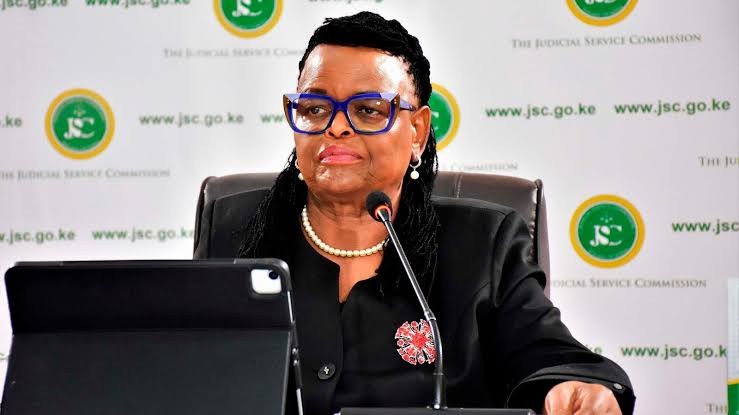
Chief Justice Martha Koome has called for higher professional standards in mediation, urging the Judiciary and stakeholders to strengthen the training, accreditation and accountability of mediators to improve the quality of dispute resolution in Kenya.
Koome said the growing acceptance of mediation as an alternative method of resolving disputes must be matched with proper training, professional competence, ethical conduct and credible accreditation systems.
Speaking during the launch of the Judiciary Mediation Action Plan, Mediation Service Charter and Mediation Case Digest, the Chief Justice emphasised the need to ensure that mediators meet high professional standards and demonstrate integrity in their work.
The launch was held under the theme, "A Decade of Court-Annexed Mediation: Restoring Relationships, Unlocking Funds, Expanding Access to Justice."
Koome called on the Mediation Accreditation Committee and other stakeholders to invest in competency-based accreditation, mentorship programmes, continuous professional development and stronger accountability mechanisms.
She noted that professionalising mediation should not translate into restricting the practice to a single profession, arguing that its strength lies in its multidisciplinary nature.
According to the Chief Justice, mediation draws expertise from different fields, including law, psychology, business, social work, engineering and banking.
She said the diversity should be preserved while ensuring that practitioners observe professional boundaries, ethical requirements and the necessary standards of competence.
Koome also highlighted the need for sustainable financing to support the long-term growth of Court-Annexed Mediation, noting that the Judiciary cannot shoulder the responsibility alone.
She called for predictable and equitable funding models that would support mediators, strengthen institutions and ensure that vulnerable and low-income litigants continue to access justice.
The Chief Justice urged government institutions, private sector players, professional bodies and development partners to contribute towards building a sustainable mediation system.
She further identified quality assurance, protection of parties' interests, improved dispute screening and evidence-based monitoring as key priorities for the next decade.
Koome cautioned against measuring the success of mediation solely through the number of disputes settled, saying other indicators must also be considered.
She said compliance with settlement agreements, user satisfaction, cost savings and the experiences of parties involved in mediation were equally important in determining its effectiveness.
The Chief Justice maintained that mediation should provide a fair, dignified and responsive process that addresses the needs of those seeking justice.
She described the launch of the three Judiciary documents as an important milestone in strengthening the direction, transparency, consistency and accountability of mediation services.
The Mediation Action Plan, Service Charter and Case Digest are expected to provide a framework for improving service delivery and guiding the continued development of Court-Annexed Mediation.
Koome also called for a national culture that embraces dialogue and encourages people to resolve disagreements through constructive engagement before conflicts escalate into lengthy disputes.
She said the Judiciary's responsibility following a decade of Court-Annexed Mediation was to ensure the system remains accessible, credible and sustainable while maintaining public confidence.
"A decade ago, through Court-Annexed Mediation, we opened a new doorway to justice. Our responsibility now is to ensure that this doorway remains accessible, credible, sustainable, and worthy of public trust," Koome said.