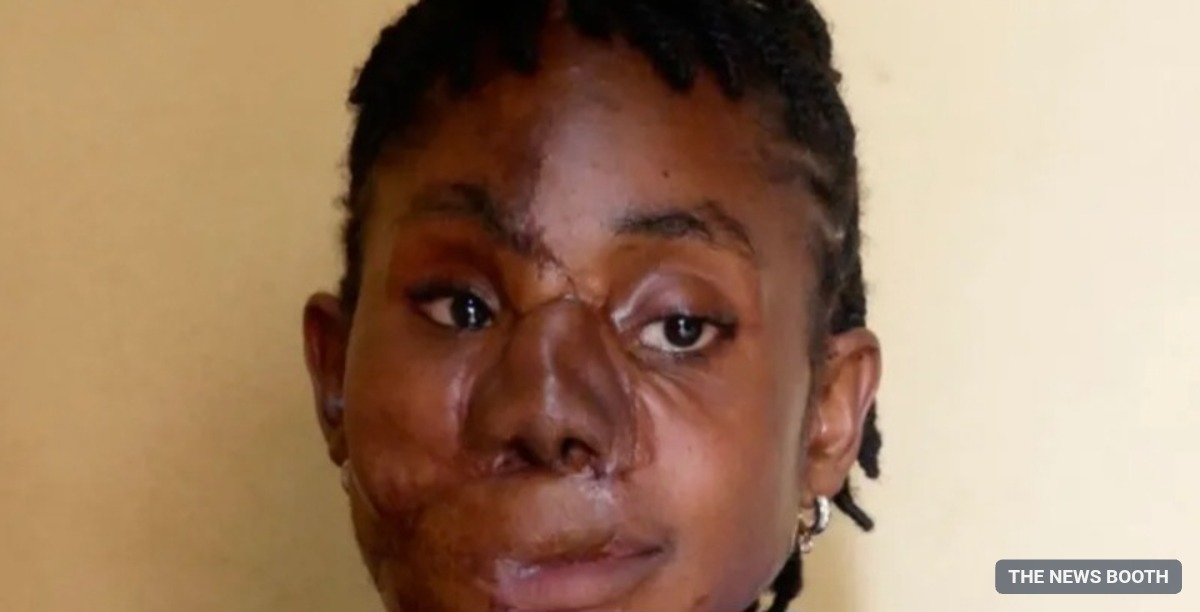
A woman who was shot several times in the face when she was just 15 years old is among thousands of people whose lives have been shattered by nearly a decade of conflict in Cameroon's English-speaking regions.
Median Bah was attacked on April 7, 2018, when armed men stormed her family's compound in the country's Southwest region.
At the time, she was unwell and resting in bed when her brother woke her after hearing gunshots and noticing armed men approaching their home.
Her brother managed to escape through a window, but Median, who says she was too weak to follow him, decided to leave through the door.
That decision brought her face-to-face with two armed attackers in the backyard, who opened fire on her.
She was first shot in the thigh before several more bullets struck her face, leaving her with life-changing injuries.
Median recalled pleading with the attackers to spare her life, explaining that she was sick and unable to defend herself. However, she collapsed and lost consciousness.
The attack left her jawbone severely damaged, destroyed most of her teeth and caused extensive injuries to her mouth and face.
Now aged 23, Median has undergone at least four reconstructive surgeries in Cameroon, Ghana and India as doctors continue efforts to repair the damage.
Some parts of her face have been reconstructed using tissue taken from other parts of her body.
She also lost the ability to breathe normally through her nose and mouth, forcing doctors to perform a tracheostomy, a procedure that creates an opening in the neck to allow air into the windpipe.
For eight years, she depended on a breathing tube before it was recently removed, allowing her to breathe normally again.
Her experience reflects the devastating impact of the Anglophone crisis, which has affected Cameroon's Northwest and Southwest regions since 2016.
The conflict began in October 2016 when lawyers and teachers in the English-speaking regions went on strike to protest what they described as marginalisation by the predominantly French-speaking government.
Among their concerns were the appointment of French-speaking judges and teachers to institutions in areas where English is widely used.
The protests initially remained peaceful, with demonstrators demanding greater recognition of the rights and identity of the Anglophone population.
However, a government crackdown, which human rights groups accused security forces of carrying out with excessive force, contributed to the emergence of an armed separatist movement.
By 2017, several armed groups had emerged, seeking independence for the two English-speaking regions and the creation of a breakaway state known as Ambazonia.
Since then, government forces and separatist fighters have been involved in a prolonged conflict marked by serious human rights violations.
Rights organisations have accused separatist fighters of killings, kidnappings, torture and attacks on schools and other facilities. Government security forces have also faced allegations of arbitrary arrests, torture and unlawful killings. Both sides have denied various accusations.
The violence has displaced hundreds of thousands of people and disrupted education, businesses and other essential services.
According to United Nations figures cited in the report, about 500,000 people have been forced from their homes, while Human Rights Watch estimates that at least 6,000 people have been killed since the conflict began.
More than 70,000 Cameroonians have also sought refuge in neighbouring Nigeria, according to the UN refugee agency, UNHCR.
Among those who fled is 44-year-old Glory Akom, a mother of two who now lives in a refugee settlement in Ogoja, in Nigeria's Cross River State.
She said her life was significantly better before the fighting intensified in 2017, when she operated a business and could comfortably provide for her family.
However, the growing insecurity forced her and other residents to abandon their homes and seek safety in the bush before eventually crossing into Nigeria.
Glory now depends on monthly assistance of about $67 from UNHCR to provide for her children, one of whom has sickle cell disease and requires regular medical attention.
The financial support, she says, is barely enough to meet their daily needs, including food and medical expenses.
Education has also suffered heavily as a result of the conflict.
Maurine Mangha, now 21, was among those forced to abandon school after separatist fighters imposed an education boycott in 2017, with threats and attacks reported against schools and people who defied the order.
She later fled to Nigeria with five family members after armed fighters opened fire during celebrations marking what they described as their independence on October 1, 2017.
Despite the disruption, Maurine secured a scholarship through a higher education programme for refugees managed by UNHCR. She is now studying microbiology at a local polytechnic.
The United Nations Children's Fund (UNICEF), citing Cameroonian education authorities, estimates that more than 200,000 children are out of school in the affected regions, while nearly 2,500 learning institutions remain non-operational.
Meanwhile, the Cameroonian government has introduced efforts aimed at ending the conflict through dialogue and rehabilitation programmes.
In September 2026, authorities launched a community dialogue initiative intended to encourage grassroots solutions and persuade separatist fighters to abandon their armed struggle.
Prime Minister Joseph Dion Ngute urged communities to engage fighters and convince them that the time had come to lay down their weapons.
The government has also continued its Disarmament, Demobilisation and Reintegration programme, with nearly 1,500 former separatist fighters undergoing rehabilitation at centres in the two English-speaking regions as of November 2026.
However, the efforts have yet to bring an end to the fighting, with separatist groups continuing to carry out attacks.