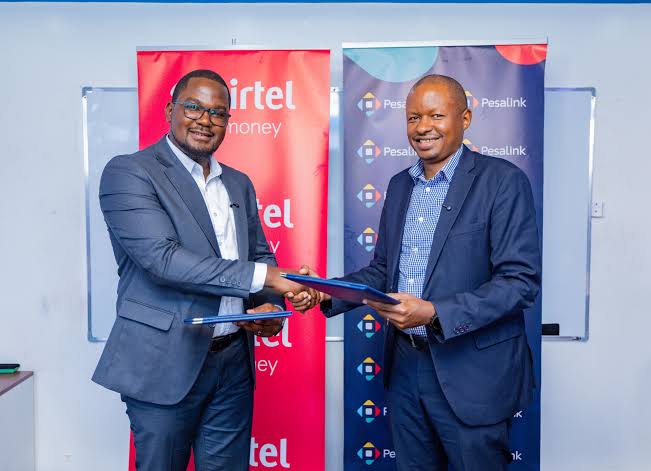
Airtel Money customers can now send money from their mobile wallets directly into bank, SACCO and microfinance accounts, after the company connected its service to Pesalink, the interbank payment system. The development was reported on November 11, 2026. With about 10.9 percent of mobile money subscriptions, Airtel Money trails Safaricom’s M-PESA.
Pesalink is the instant account-to-account payment system operated by IPSL for the Kenya Bankers Association. It links more than 80 institutions, and it allows real-time transfers between bank accounts. By joining it, Airtel Money gives its wallet users access to the banks, SACCOs and microfinance banks that M-PESA users have long been able to reach through their own links.
Transfers are subject to the limits that apply across mobile money. The Central Bank of Kenya set the largest single mobile money transaction at KES 250,000 in 2023, a cap that covers Airtel Money and M-PESA alike. Customers moving larger sums will still need to split payments or use a bank-to-bank channel.
Airtel Money’s bank links have been building for some time. In April 2026, the company partnered with Absa Bank Kenya to allow direct transfers from Airtel wallets into Absa accounts, along with payments to Absa merchant paybill numbers. Airtel has also signed earlier arrangements with I&M Bank, which charged a fee of KES 30 for transfers from Airtel to I&M accounts.
Airtel Money is far smaller than its rival. The Communications Authority reported 53.4 million mobile money subscriptions in the first quarter of 2026, of which Safaricom held 89.1 percent. Airtel’s share of 10.9 percent works out to about 5.8 million subscriptions. The Pesalink link is aimed at narrowing the gap by making its wallet useful for business and savings customers.
The shift is part of a broader change in how Kenyans move money. The Central Bank of Kenya recorded mobile money agent transactions of KES 633.35 billion in February 2026, but transaction volumes have been declining as more users move funds directly between wallets and bank accounts. Direct links reduce the number of steps needed to move money.
The move matters most for small businesses. Traders who receive payments in mobile wallets often have to withdraw cash or make manual transfers before they can pay suppliers or save. Direct wallet-to-bank transfers can shorten that process and make reconciliation easier, as Airtel’s Absa partnership was designed to do.
Airtel has also been expanding its offering for small businesses. Its Bizna wallet, launched in August 2026, is positioned as a rival to Safaricom’s Pochi la Biashara, a product aimed at merchants who want to keep business receipts separate from personal money.
The next signals will be the fees Airtel charges on Pesalink transfers, the uptake among SACCOs and microfinance banks, and any changes to transaction limits from the regulator. Those details will show whether the link changes customer behaviour in a market dominated by M-PESA.