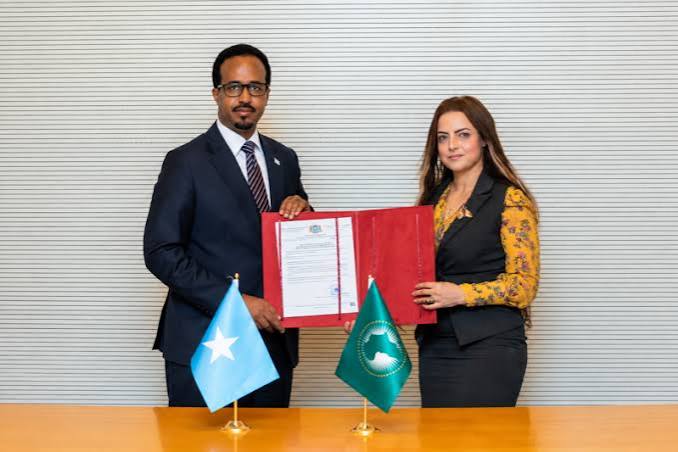
Somalia has officially joined the African Continental Free Trade Area (AfCFTA), becoming the 50th country to ratify the continental trade agreement and opening a new chapter in its regional economic integration. The Horn of Africa nation completed its accession on September 4, 2026, after depositing its ratification instrument at the African Union headquarters in Addis Ababa, Ethiopia.
The development gives Somali businesses and investors a framework for pursuing preferential trade with participating African countries, potentially expanding export markets and improving opportunities to attract investment. The agreement brings together countries representing a market of more than 1.4 billion people, with a combined gross domestic product estimated at approximately $3.4 trillion.
Somalia’s Minister of Commerce and Industry, Gamal Mohamed Hassan, submitted the ratification instrument following parliamentary approval and presidential assent by President Hassan Sheikh Mohamud. The move completed the country’s formal accession process, which began when Somalia signed the AfCFTA agreement in Kigali, Rwanda, on March 21, 2018.
The government expects membership to help Somali companies diversify exports, participate in regional value chains and reach customers beyond domestic borders. Somalia’s established exports include livestock, sesame and other oilseeds, while fisheries, hides and skins offer additional opportunities for expanding trade.
The agreement could also support investment in logistics, agriculture, processing and other industries by providing a broader regional market for goods and services. Businesses that can meet common rules of origin and applicable trade requirements may benefit from preferential tariff arrangements when exporting eligible products to participating countries.
However, formal membership does not mean that all Somali goods can immediately enter African markets without customs duties. Somalia must align its tariff schedules, integrate applicable preferential tariffs into its customs systems and put the required trade procedures in place before exporters can fully use the agreement’s benefits. The AfCFTA Secretariat has said implementation work will continue with the Somali authorities.
The Ministry of Commerce and Industry is expected to coordinate domestic implementation, including preparing exporters, cooperatives and small and medium-sized enterprises for the new trading framework. This will involve helping businesses understand documentation requirements, product standards, customs procedures and the conditions for qualifying for preferential treatment.
Somalia’s membership also strengthens its participation in the wider East African and continental trade system. The country joined the East African Community in 2024 and is also part of the Common Market for Eastern and Southern Africa (COMESA). These regional frameworks can serve as building blocks for wider African economic integration, although businesses must still navigate the specific rules and obligations applicable under each arrangement.
The AfCFTA, whose trading phase began in January 2021, aims to reduce trade barriers, encourage cross-border investment and make it easier for African businesses to sell goods and services across national borders. Its long-term success depends on countries implementing tariff commitments, improving transport links and addressing non-tariff barriers that can make cross-border trade expensive and unpredictable.
For Somalia, the immediate task is to turn formal membership into practical commercial opportunities. The pace of progress will depend on customs readiness, business awareness, infrastructure and the ability of local producers to meet demand in other African markets.
The accession nevertheless gives Somalia a stronger institutional platform for engaging in continental trade negotiations and preparing businesses for regional competition. As implementation advances, the government will need to ensure that exporters understand the new rules and that the necessary systems are in place to translate membership into increased trade, investment and employment.