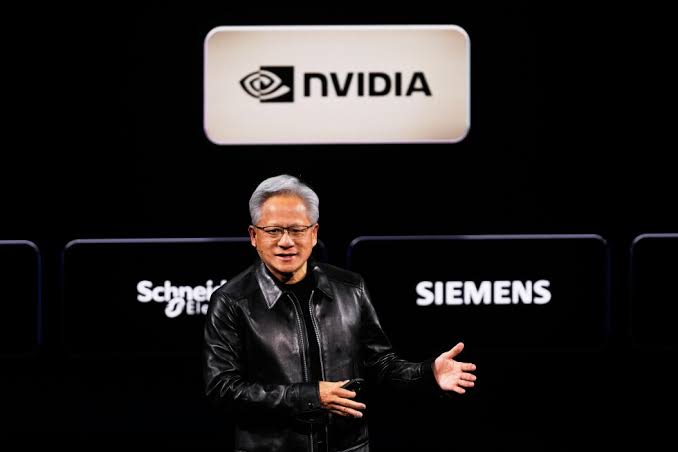
Siemens has said its cooperation with Nvidia will remain unaffected by uncertainty surrounding the US chipmaker's leadership, with Chief Executive Roland Busch maintaining that joint projects depend on teams across both companies rather than individual executives.
Speaking on Thursday, November 12, 2026, after Siemens released its fourth-quarter results, Busch said the German industrial technology group expected no disruption to its partnership with Nvidia, despite reports that the latter's board was considering the future of founder and Chief Executive Jensen Huang.
Busch said the collaboration involved a large organisation with teams working across different management levels. He noted that day-to-day project activities were handled by executives and technical teams, including Nvidia Vice President Rev Lebaredian, rather than depending directly on Huang.
He added that decisions concerning Nvidia's leadership were a matter for its board, while the company's operations and commercial relationships would continue regardless of the outcome.
The leadership uncertainty follows reports of alleged personal controversies involving Huang, including claims of relationships that have attracted scrutiny within the company. The developments have raised questions about succession planning and governance at the artificial intelligence chipmaker.
However, Siemens' position highlights the extent to which its relationship with Nvidia has become embedded in broader industrial technology projects.
The two companies have expanded their partnership to develop artificial intelligence-powered factories, digital twins and autonomous manufacturing systems. Their collaboration combines Nvidia's AI computing and simulation platforms with Siemens' industrial software, automation and engineering expertise.
In October 2026, the companies showcased new applications at Siemens' electronics factory in Erlangen, Germany. These included virtual production planning and AI-powered quality inspection, with Siemens reporting that virtual production preparation could reduce engineering effort by up to 85%.
The partnership also covers infrastructure for AI factories, including electrical distribution, automation and digital simulation systems designed to accelerate data-centre construction and improve operational efficiency.
Siemens and Nvidia announced an expanded collaboration in January 2026, with ambitions to develop fully AI-powered manufacturing facilities.
Busch's comments suggest that Siemens intends to maintain its industrial AI strategy irrespective of Nvidia's internal leadership developments. Investors and technology customers will be watching whether the partnership continues delivering planned projects as both companies expand their presence in industrial artificial intelligence.