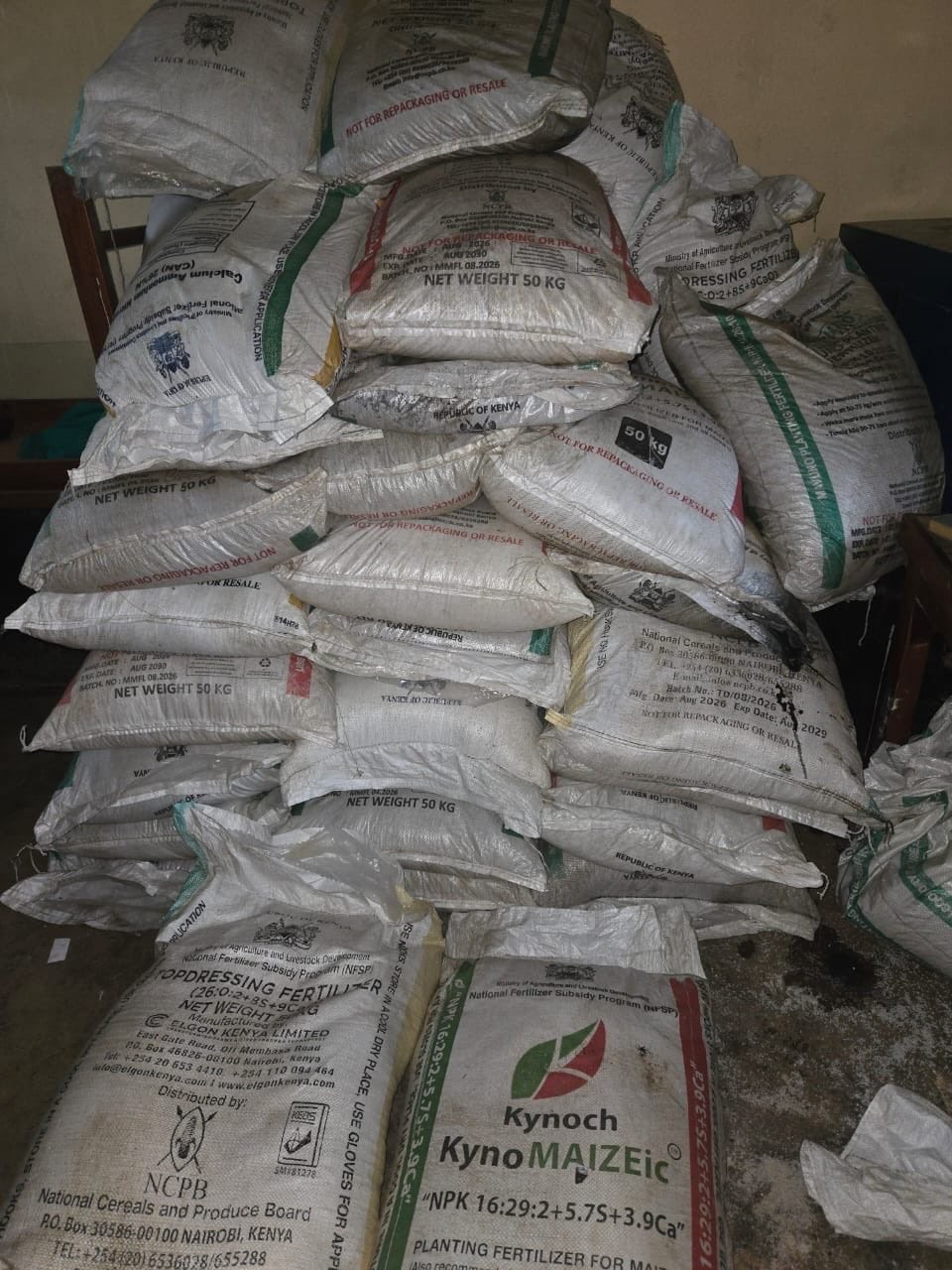
Three women have been arrested following the recovery of 55 bags of government-subsidised fertiliser allegedly being sold illegally in Migori Township.
The suspects, identified as Esther Mwera, Emily Akinyi and Elizabeth Kisili, reportedly led detectives to their respective stores after being questioned.
The arrests followed a tip-off from members of the public, prompting detectives from Suna East to move to Apida area in Suna Central Location, where they discovered the fertiliser, prominently marked “NOT FOR SALE,” being offered for sale in apparent violation of regulations governing the distribution of subsidised farm inputs.
A subsequent search resulted in the recovery of 55 bags of the fertiliser, which were seized as exhibits.
The three women were escorted to Migori Police Station alongside the recovered fertiliser and booked pending further police action.
The Directorate of Criminal Investigations (DCI) has commended members of the public for providing timely information that helps detectives uncover criminal activities and safeguard public resources.
The agency has urged Kenyans to continue sharing information with law enforcement officers to help curb the illegal diversion and sale of government-subsidised commodities intended to support farmers and boost agricultural production.
The government-subsidised fertiliser program is a strategic initiative by the Kenyan government designed to lower production costs and boost food security across the country.
Under the initiative, the retail price of a 50-kilogram bag of fertiliser has been set at KSh 2,000, heavily discounted from commercial market rates.
To prevent hoarding, middleman exploitation, and diversion of stock, the distribution process is tightly regulated and managed directly through the National Cereals and Produce Board (NCPB) depots and authorised local cooperatives.
To benefit from this subsidy, farmers must participate in a digital vetting system by registering on the Kenya Integrated Agriculture Management Information System (KIAMIS).
This system links a farmer's National ID and mobile number to their specific acreage and crop types, ensuring that fertiliser is allocated fairly based on actual farm sizes.
When purchasing, transactions are entirely digital and cashless—primarily handled via M-Pesa—and the registered farmer must present themselves in person with their original ID, as proxy buying and third-party collections are strictly prohibited to maintain program integrity.