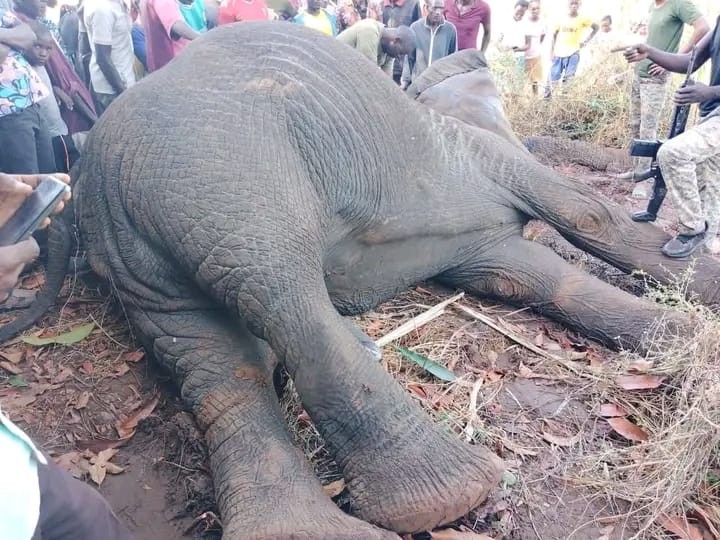
The Kenya Wildlife Service (KWS) has killed an elephant that fatally attacked a person in Kamaindi area, Tharaka Ward, after the animal was found hiding on a farmer’s land hours after the incident.
The elephant was shot dead by KWS officers following public outcry over the fatal attack, which raised renewed concerns about the growing threat posed by human-wildlife conflict in the area.
The animal had reportedly been roaming the area for several weeks before the attack.
Its presence had heightened concerns among residents, particularly those living and working near farms and areas frequented by wildlife.
Following the incident, KWS officers moved in and tracked down the elephant at a farm belonging to a local resident identified as Mkulima.
The animal was subsequently put down, with its carcass expected to be burnt to ashes in accordance with wildlife disposal procedures.
The incident adds to the growing number of human-wildlife conflict cases reported across Kenya, where encounters between people and wild animals have resulted in deaths, injuries, destruction of crops and damage to property.
Data published by the Kenya Wildlife Service for the 2024/2025 financial year recorded 9,929 human-wildlife conflict incidents nationally.
The cases included 131 human deaths, 341 injuries, 5,596 crop-destruction incidents, 573 cases of property damage, 515 cases of wildlife-related animal mortality and 2,772 livestock-predation incidents.
Elephants are among the most dangerous wild animals when encounters with humans turn hostile because of their enormous size, strength and ability to move quickly over short distances.
An adult elephant can cause fatal injuries by charging, trampling or using its tusks, leaving people with little time to escape when confronted at close range.
Although elephants generally do not seek out humans to attack, they may become aggressive when startled, injured, threatened, protecting their young or unable to find an escape route.
Encounters can also become dangerous when elephants enter farms and settlements in search of food and water, particularly where human activity has disrupted their natural habitats and movement corridors.
Human-elephant conflict has become a major conservation and public safety challenge in parts of Kenya as settlements and agricultural activities expand into wildlife habitats.
Elephants raiding farms can destroy crops within a short period, threatening household incomes and food security while exposing farmers to potentially fatal encounters as they attempt to protect their livelihoods.
Residents are advised to avoid approaching or attempting to chase elephants away when they encounter them.
They should keep a safe distance, warn others nearby and report sightings or dangerous animal behaviour to KWS officers for professional intervention.
The latest incident has renewed calls for stronger measures to protect communities living near wildlife habitats, including improved early-warning systems, protection of wildlife corridors and timely responses to reports of dangerous animals.
While the killing of the elephant is expected to ease immediate fears among residents, the incident highlights the continuing challenge of balancing wildlife conservation with the safety and livelihoods of communities living alongside wild animals.