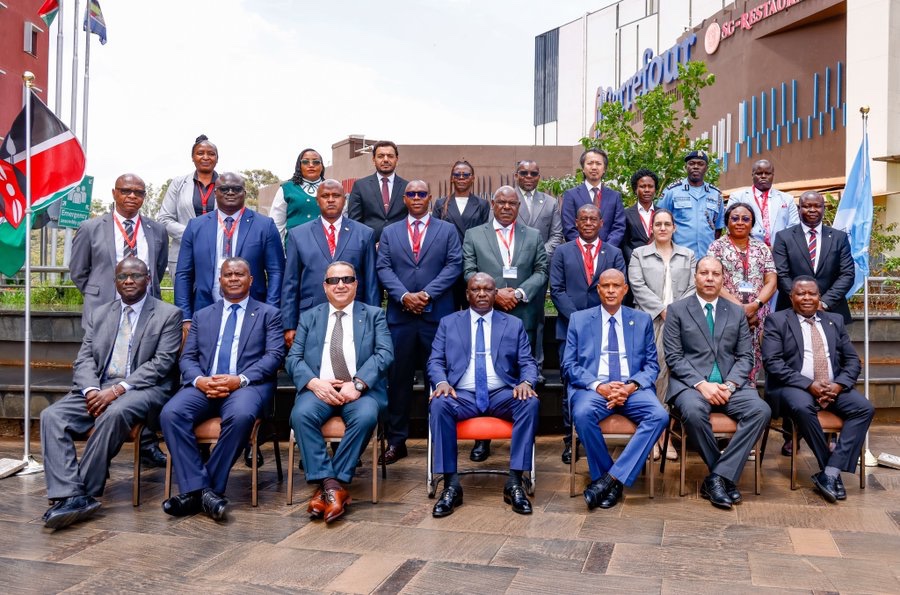
Kenya is pushing for stronger regional policing cooperation as Inspector General of Police Douglas Kanja opened the fifth INTERPOL African Committee meeting in Nairobi on Monday, October 26, bringing together delegates from across the continent to discuss responses to transnational crime.
Kanja said African countries must strengthen partnerships, share intelligence and coordinate operations to address criminal networks that operate across national borders, reaffirming Kenya’s commitment to joint security initiatives and capacity development.
The meeting, held at the Holiday Inn in Nairobi, provides a platform for delegates to assess progress on previous recommendations, identify emerging security threats and establish priorities for coordinated law enforcement across Africa, according to the National Police Service.
Kanja said the committee’s deliberations and resolutions were important in developing collective responses to the continent’s security challenges, expressing confidence that stronger institutional partnerships and regional ownership of security initiatives would help protect citizens.
Director of Criminal Investigations Mohamed I. Amin, who represents Africa on the INTERPOL Executive Committee, highlighted the importance of intelligence sharing and coordinated operations in tackling transnational crime.
Amin cited Operation Serengeti as an example of how joint action can help investigators target criminal networks operating across borders. He identified terrorism, drug trafficking, illicit arms trade and illegal mining among the persistent threats requiring a unified regional response.
The emphasis on cross-border cooperation comes as INTERPOL continues to coordinate multinational operations against organised and technology-enabled crime.
In its latest Operation Serengeti III crackdown, conducted between June 29 and August 31, 2026, law enforcement agencies from 21 countries arrested 1,462 suspects, disrupted 10,909 malicious networks and recovered more than $105 million in illicit funds.
INTERPOL reported on October 22 that investigators identified 65,929 victims targeted by cybercriminal networks, with investigations linking the criminal activity to losses exceeding $385 million. Kenya was among the participating countries.
The operation demonstrates the scale of criminal activity that can span several jurisdictions and the role of coordinated investigations in identifying suspects, disrupting networks and tracing proceeds of crime.
The Nairobi meeting also provides an opportunity to review the implementation of earlier recommendations and prepare for the 28th INTERPOL African Regional Conference, scheduled to take place in Addis Ababa, Ethiopia, next year.
The African Committee was established following the 27th INTERPOL African Regional Conference held in Cape Town, South Africa, from August 27 to 29, 2025. Its mandate includes setting regional priorities and advising on crime threats and prevention strategies.
At that conference, police leaders backed stronger intelligence exchange, improved border cooperation and increased use of INTERPOL resources to combat organised crime, cybercrime and terrorism.
Other officials attending the Nairobi meeting include INTERPOL Vice President for Africa Mohamed Dkhissi, African Committee Chairperson Ibrahim Amr, Head of INTERPOL’s Regional Bureau for Eastern Africa Africa Apollo, and INTERPOL General Secretariat Assistant Director Immanuel Sam.
Kenyan representatives include National Criminal Investigations Academy Commandant Ibrahim Jillo, who also represents Kenya on the African Committee, National Central Bureau Kenya head Mueni Mutisya and National Police Service spokesperson Muchiri Nyaga.
The meeting is expected to help shape the region’s policing priorities as African law enforcement agencies seek more coordinated approaches to criminal threats that extend beyond national borders.