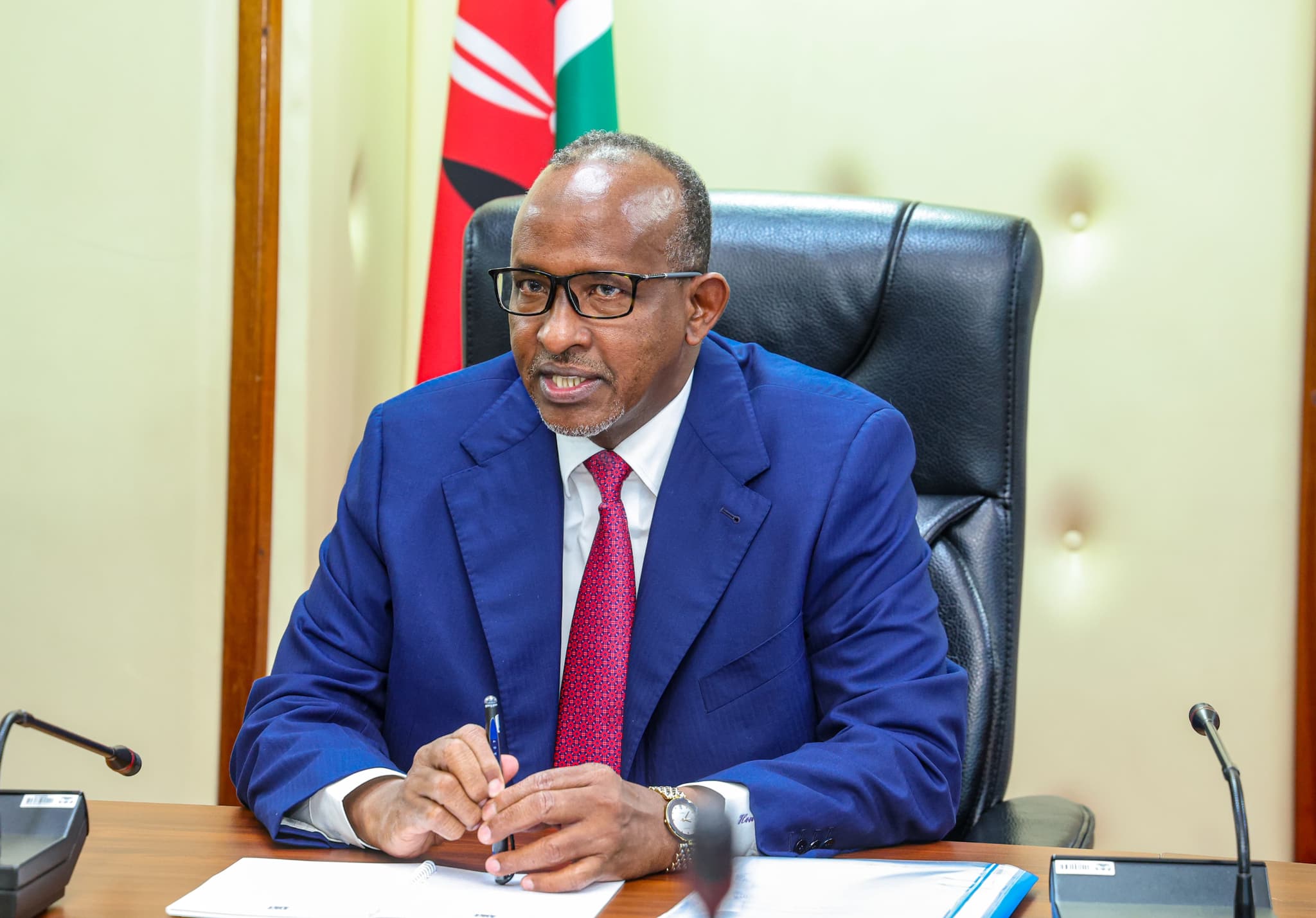
Health Cabinet Secretary Aden Duale has rejected remarks by Controller of Budget Margaret Nyakang’o suggesting that some public funds and levies fall outside effective oversight, saying the characterisation misrepresents the legal framework governing the funds.
Duale, responding in a statement, said funds established through legislation have defined mechanisms for their management, withdrawal and audit and remain subject to scrutiny by the Auditor-General and Parliament.
“Our attention has been drawn to public remarks by the Controller of Budget suggesting that certain public funds fall outside any framework of oversight and accountability. This characterisation is inaccurate and requires clarification,” Duale said.
His response followed remarks by Nyakang’o in which she raised concerns over her office’s ability to track billions of shillings collected through government funds and statutory levies.
Nyakang’o said her office had no visibility into the expenditure of some funds and levies that are not part of the Consolidated Fund.
“No visibility at all. Anything called a fund or a levy, we will not see it, are not part of the Consolidated Fund,” she said.
Among the funds and levies she cited were the Affordable Housing Levy Fund, Social Health Insurance Fund, Hustler Fund, National Infrastructure Fund and Uwezo Fund, as well as the Affordable Housing Levy, Social Health Insurance, Road Maintenance Levy, Railway Development Levy and Air Passenger Service Levy.
Nyakang’o questioned whether the existing arrangements provide sufficient safeguards and reporting mechanisms to enable effective oversight of public resources.
“Many times, I have felt that we have gone out of the safeguards the Constitution has provided. For instance, why don’t they have a reporting mechanism whereby the reports are scrutinized?” she posed.
She further raised concerns over the possible use of public resources for political activities as the country heads towards the 2027 General Election, citing expenditure and the use of government vehicles and human resources at partisan events.
Duale, however, said the mandate of the Office of the Controller of Budget is clearly defined under Article 228 of the Constitution and the Controller of Budget Act, 2016.
He said Article 228(4) gives the Controller of Budget authority to authorise withdrawals from the Equalisation Fund, Consolidated Fund and County Revenue Funds, as well as from other public funds where an Act of Parliament expressly places such withdrawals under her approval.
Duale added that Article 228(5) requires the Controller, in exercising that mandate, to confirm that withdrawals are authorised by law.
According to the CS, the funds cited by Nyakang’o were established through their respective legislation, which provides for how they are managed, how withdrawals are made and how they are audited.
“They remain fully subject to the oversight of the Auditor-General and Parliament,” Duale said.
He argued that describing funds lawfully appropriated and administered under an Act of Parliament as being beyond scrutiny would amount to a misrepresentation of both the law and the facts.
Duale nevertheless acknowledged the constitutional independence of the Controller of Budget, saying the Government respects the office's independence.
He maintained, however, that such independence must be exercised through the constitutional and statutory mechanisms provided for the office, including reports to Parliament and the lawful approval of withdrawals.
Duale also pointed to proposed amendments to the Public Finance Management Act that would expand oversight of funds and levies outside existing budget channels.
He said the proposed amendments are already before Parliament and that the Government welcomes debate on the issue.
The exchange has brought renewed attention to how funds and levies established outside the Consolidated Fund are managed, reported and subjected to oversight, as questions continue over the accountability mechanisms governing billions of shillings collected from Kenyans.