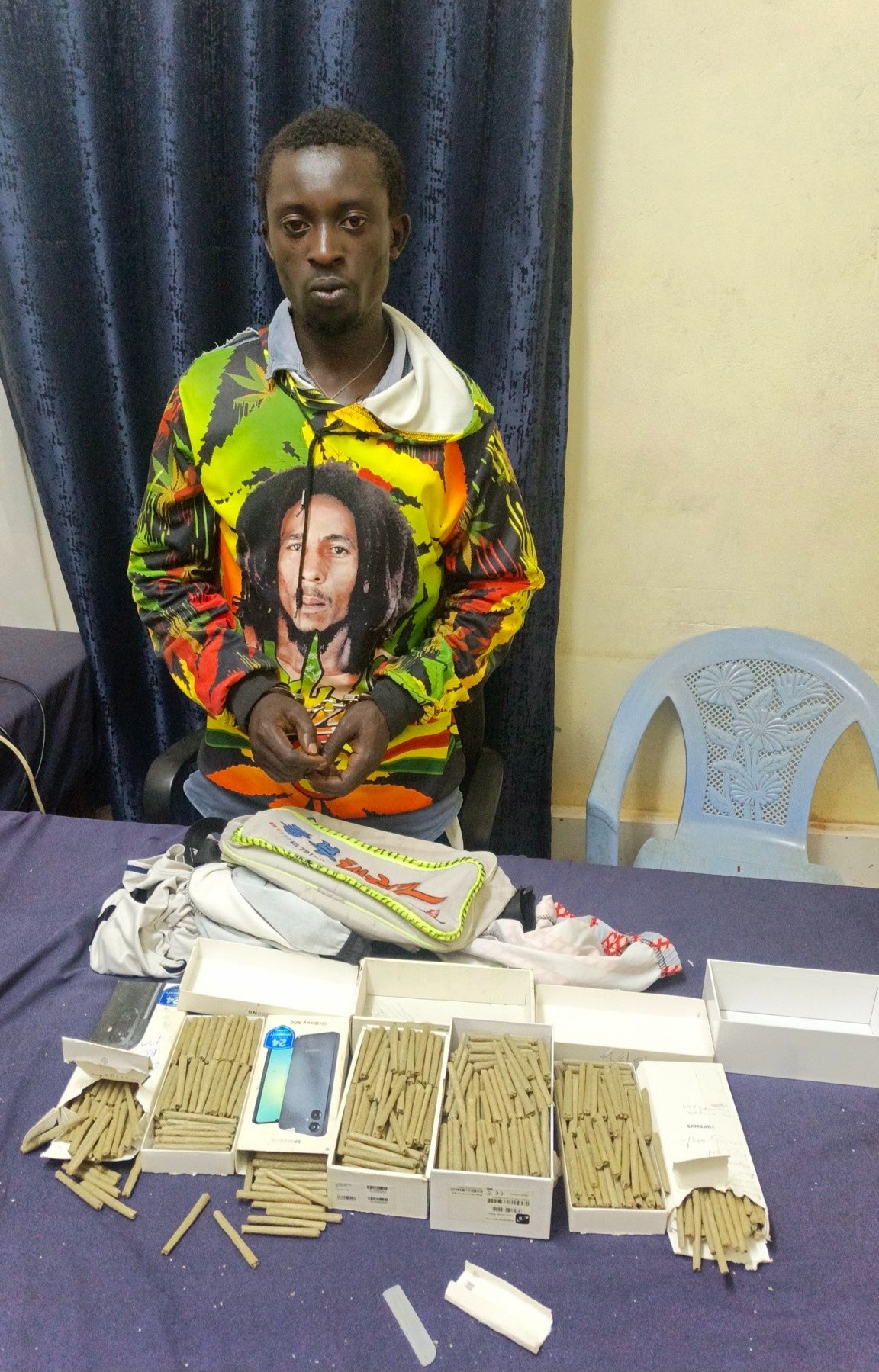
A 25-year-old man has been arrested in Busia after detectives allegedly found 1,121 rolls of bhang concealed inside mobile phone boxes as he prepared to board a Nairobi-bound bus.
The suspect, identified as Titus Okware, was intercepted by officers from the National Anti-Narcotics Investigations Bureau (NANIB) following intelligence that narcotic drugs were being transported to the capital.
According to the report, detectives moved in just as Okware was about to board the bus, stopping him for a search.
Although the suspect was carrying a small bag that appeared harmless, officers discovered seven mobile phone boxes inside.
However, instead of containing mobile phones, the boxes were allegedly stuffed with 1,121 rolls of bhang.
The discovery led to his immediate arrest, bringing the suspected attempt to transport the narcotics to Nairobi to an end.
Okware was subsequently taken to Busia Police Station, where he is being processed ahead of arraignment in court.
The recovered narcotics have been secured as exhibits as investigations continue.
The arrest highlights the use of concealed packaging in suspected drug trafficking operations, with law enforcement officers relying on intelligence-led operations to intercept narcotics before they reach their intended destinations.
The suspect is expected to be presented in court to face charges related to the alleged possession and transportation of narcotic drugs.
The possession, trafficking and cultivation of bhang outside the provisions permitted by law are criminal offences in Kenya under the Narcotic Drugs and Psychotropic Substances (Control) Act, Cap. 245.
Section 3 of the Act provides for penalties for unlawful possession of narcotic drugs, including cannabis.
The law also provides for offences relating to trafficking and cultivation.
Article 2(1) of the Constitution of Kenya, 2010, establishes the Constitution as the supreme law of the Republic, binding on all persons and State organs.
Article 2(4) further provides that any law or act that contravenes the Constitution is invalid to the extent of the inconsistency.
The specific offences and penalties relating to bhang are provided for under legislation enacted by Parliament, rather than directly under the Constitution.