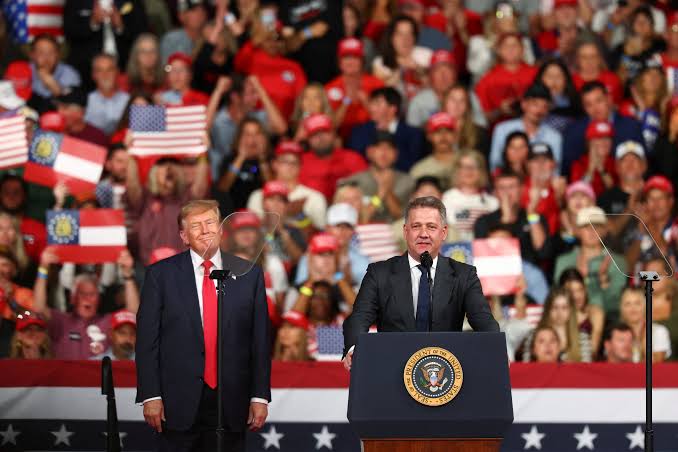
Audi chief executive Gernot Döllner is facing criticism from Germany’s largest industrial union after appearing alongside US President Donald Trump at a campaign rally in Georgia, where the president announced plans for a proposed $4 billion Audi manufacturing plant. The October 24 appearance has raised questions about corporate political neutrality less than two weeks before the November 3 US midterm elections.
Döllner joined Trump on stage at the rally in Perry, near Macon, as the president presented the proposed investment as evidence that his trade policies were encouraging foreign manufacturers to expand production in the United States. The factory is expected to produce up to 200,000 premium sport utility vehicles annually, creating approximately 4,500 jobs, according to Audi.
Christiane Benner, president of IG Metall and deputy chair of Volkswagen’s supervisory board, strongly criticised Döllner’s decision to participate in the event. In a statement on October 26, she described his appearance as politically unacceptable and said it violated Audi’s rules requiring political neutrality ahead of elections.
Audi’s code of conduct states that the company should not make public appearances with political parties or politicians seeking election, or sponsor related events, during the final three months before an election. The union argues that Döllner’s participation at Trump’s rally breached this restriction.
The controversy comes as Volkswagen, Audi’s parent company, faces pressure to reduce costs and restructure operations amid weaker demand in China, competition from Chinese manufacturers and the financial burden of US import tariffs. Audi has said tariffs cost it approximately €1.2 billion last year because its vehicles sold in the American market are imported from Europe or Mexico.
Döllner defended his decision to attend the rally, saying the investment had been preceded by months of planning and negotiations. He told reporters that accepting an invitation from the US president demonstrated respect for the office and the country in which Audi intends to invest.
The proposed plant would mark Audi’s first vehicle assembly facility in the United States. Production is expected to focus on its largest premium SUVs, including the Q7, Q8 and Q9, with construction scheduled to begin in 2027 and manufacturing starting in the early 2030s.
Audi’s expansion is intended to strengthen its position in North America by manufacturing vehicles closer to customers and reducing exposure to import tariffs. Trump has repeatedly argued that tariffs encourage foreign companies to establish American factories, although critics say the duties can also increase costs for businesses and consumers.
However, the investment remains subject to approval by Volkswagen’s supervisory board. Benner said employee representatives would examine the proposal alongside demands for clear employment guarantees at the group’s German facilities.
The union’s concerns reflect wider tensions within Volkswagen as the company seeks to balance international growth with job security at home. German state premier Olaf Lies, whose state of Lower Saxony is Volkswagen’s second-largest shareholder, has also said that expanded US production should benefit workers and preserve economic value in Germany.
The dispute places Döllner’s public appearance under scrutiny as Audi pursues a major expansion in the US market. The outcome of Volkswagen’s approval process and any subsequent commitments to employees will help determine how the proposed investment affects the group’s manufacturing strategy on both sides of the Atlantic.