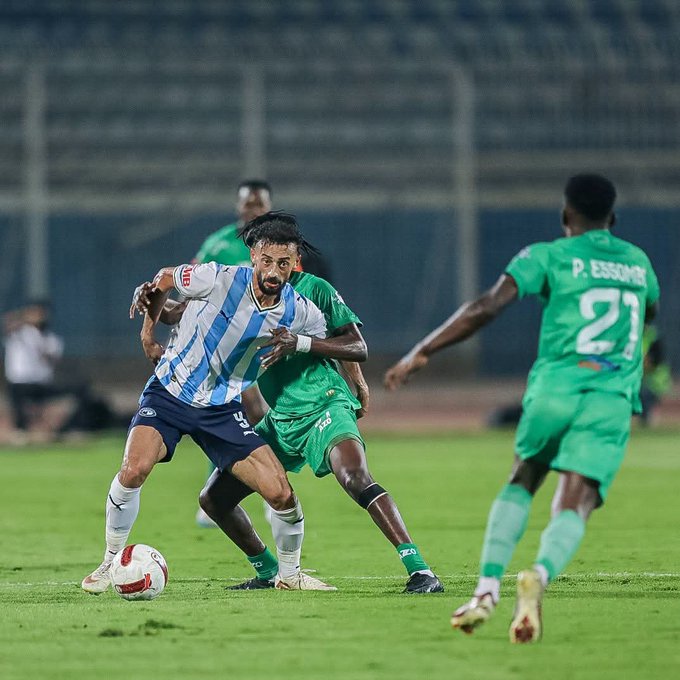
Kenyan record Premier League champions Gor Mahia's 7-1 aggregate defeat to Pyramids in the CAF Champions League was less about one disastrous performance and more about a series of tactical problems that became increasingly difficult to contain over the two legs.
Pyramids, the reigning African champions after beating Mamelodi Sundowns 3-2 on aggregate in last season's final, exposed the gap between Gor Mahia's intensity and the Egyptians' ability to control space, transitions and the tempo of the tie.
The warning signs were already evident in Nairobi. Gor Mahia started with ambition, pressing high and attempting to disrupt Pyramids' build-up.
But the problem with the press was not its aggression; it was the lack of protection behind it. Once the first line of pressure was beaten, Pyramids found considerable space between Gor's midfield and defence.
The Kenyan champions were often left defending large areas with their backline exposed, giving the Egyptian side opportunities to attack quickly.
Pyramids were particularly effective at exploiting the spaces created by Gor's advanced full-backs and midfielders.
Rather than forcing the ball through the congested centre, they frequently moved possession into the channels and half-spaces, where Gor's defensive structure was at its most vulnerable.
The Egyptian side's ability to switch the point of attack also meant that Gor's players were regularly forced to turn and retreat rather than step forward and engage.
The midfield was another decisive battleground. Gor struggled to establish control in the centre, while Pyramids were able to circulate possession with greater composure and move players into advantageous positions.
Their midfielders did not simply look to receive the ball; they constantly manipulated Gor's defensive shape, pulling opponents out of position and opening passing lanes for the next player.
Gor, by contrast, increasingly looked as though they were chasing the ball.
That distinction became crucial. There is a difference between pressing with intensity and controlling a match. Gor had the former, but Pyramids had the latter.
Once the Egyptians established control of the central areas, they could dictate when to accelerate and when to slow the game down.
Pyramids' attacking movements also created difficult decisions for Gor's wide defenders. Their use of width combined with inside movements repeatedly produced situations where Gor had to choose between protecting the flank and closing the spaces inside.
When the full-back moved wide, the inside channel opened; when he narrowed his position, Pyramids could exploit the space outside.
These were not simply individual defensive errors but problems created by coordinated movement.
The timing of Pyramids' goals made the situation even worse. Their early breakthrough in Nairobi meant Gor's aggressive opening was immediately undermined.
Instead of forcing Pyramids to react to them, Gor were forced to react to the scoreline.
The second goal, arriving just before half-time, was particularly damaging because it changed the tactical equation completely.
A team already struggling to control midfield suddenly had to chase a two-goal deficit against the reigning African champions.
That also exposed another weakness: Gor's possession became increasingly predictable. Once they had to attack, much of their threat came from the wide areas, with the ball frequently moving from the centre to the full-back or winger before ending with a cross.
Pyramids were comfortable defending this pattern because their centre-backs could deal with deliveries into the box while their midfield remained compact in front of them.
What Gor needed was greater variation, particularly through the half-spaces. Quick combinations, third-man runs and movements between the lines could have forced Pyramids' defensive block to shift more frequently.
Instead, the attacks often became easier to read, allowing Pyramids to defend without having to commit too many players.
The biggest problem, however, was Gor's defensive transition. Every time the Kenyan side committed numbers forward, they left space behind the ball.
When possession was lost, Pyramids were much better equipped to exploit those spaces.
Their first pass after winning possession was often purposeful, taking several Gor players out of the game and turning a promising Gor attack into an Egyptian counterattack.
This became even more pronounced in Cairo. Trailing 2-0 from the first leg, Gor had little choice but to attack. But the aggregate scoreline also gave Pyramids an enormous tactical advantage.
The Egyptians did not need to take unnecessary risks. They could absorb pressure, wait for mistakes and attack the spaces Gor were inevitably going to leave behind.
That was the trap Gor could not escape. The more urgently they searched for goals, the more vulnerable they became.
The more players they committed forward, the greater the space available for Pyramids to counter. And every Pyramids goal made Gor's tactical problem even more severe.
There were attempts to change the game. Gor adjusted their midfield and became more aggressive, but the changes were largely reactive.
The fundamental issue was not simply the number of attacking players on the pitch; it was the structure supporting them. Adding more players forward without establishing adequate protection behind the ball only increased the risk.
This is where Pyramids' experience as continental champions showed. They understood the game state better. They knew when to press, when to retreat and when to exploit the spaces created by Gor's desperation.
Their football was not necessarily based on constant attacking pressure. It was based on making the right decision at the right moment.
For Gor Mahia, the technical lesson should therefore not be that they need to abandon their aggressive approach. Instead, they need to make it more sophisticated.
A high press must be accompanied by a clear rest-defence structure. When the full-backs advance, someone has to protect the channels behind them. When midfielders press, there must be cover behind the press.
And when possession is lost, the team must either counter-press immediately or retreat into a clearly defined defensive shape.
The tie also highlighted the need for greater tactical flexibility in possession. Against opponents of Pyramids' quality, simply moving the ball wide and delivering crosses is unlikely to be enough.
Gor need to become better at manipulating defensive blocks through central combinations, quick rotations and movements between the lines.
Ultimately, the 7-1 aggregate scoreline tells a story of more than a difference in individual quality.
Pyramids were better at managing space, transitions and the psychological demands of a two-legged Champions League tie. Gor Mahia had energy and commitment, but their structure repeatedly broke down when their initial pressure was bypassed.
The painful conclusion for K’Ogalo is that the second leg did not create the problems; it magnified problems that had already been visible in Nairobi.
Pyramids simply became more ruthless in exploiting them.
For Gor Mahia to compete consistently at this level, the next evolution must be from intensity to control.
Continental football punishes teams that are stretched, predictable or tactically impatient.
Against Pyramids, Gor Mahia were all three at different stages of the tie—and the reigning African champions made them pay.