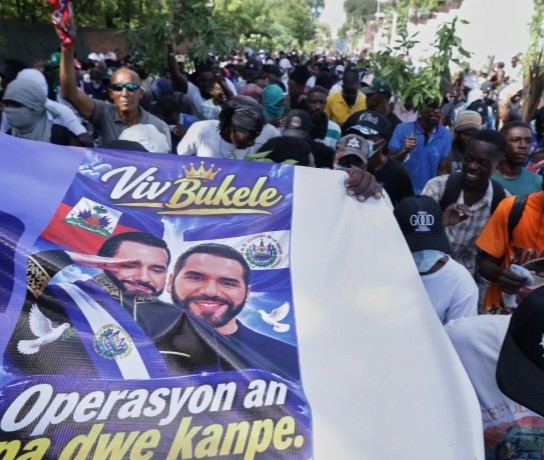
Thousands of people took to the streets of Haiti's capital, Port-au-Prince, and other parts of the country on Tuesday to show support for El Salvador President Nayib Bukele and his troops deployed to help fight armed gangs.
The demonstrators praised the Salvadoran forces for their efforts to restore security in the Caribbean nation, which has experienced years of violence, killings and displacement caused by powerful gangs.
Some protesters carried placards urging Bukele not to withdraw his troops, with one message reading: “Keep fighting … because otherwise, they'll end up killing us all.”
Public support for Salvadoran troops
Others called for more security equipment, including drones and robot dogs, to strengthen the ongoing operation against gangs controlling large parts of the country.
The calls came as explosive drones have reportedly been used to target gang-controlled areas, while robot dogs recently unveiled by security forces have also been seen operating in parts of Port-au-Prince.
The demonstrations came as Haiti's government moved to strengthen its security cooperation with El Salvador, with Justice Minister Patrick Pélissier saying there was no fixed date for the departure of the Salvadoran troops.
Speaking to reporters in El Salvador on Tuesday night, Pélissier said the troops were needed to support Haitian police at least until elections are held next year.
He added that the two governments would work on establishing a legal framework that would allow the Salvadoran forces to remain in Haiti for a longer period.
Meanwhile, Haiti's government announced that its Council of Ministers had ratified a cooperation agreement between the two countries, although it did not provide further details about the arrangement.
Haiti's government cooperation efforts
Bukele deployed approximately 2,500 troops to Haiti last month to support local security forces in their fight against armed gangs.
The deployment followed an attack on four Salvadoran troops on October 18. The four soldiers remain missing.
Since the arrival of the foreign forces, fighting between gangs and security personnel backed by Haitian authorities has intensified as the country continues to struggle with widespread insecurity.
Impact of gang violence on residents
More than 20,000 people have been killed in Haiti over the past five years, while gangs are estimated to control about 70 per cent of the capital, Port-au-Prince.
For many residents who joined Tuesday's march, the Salvadoran troops represent hope for an end to the violence that has disrupted their lives.
One of the protesters, Maxseau Lomba, said gangs had forced his family from their home, destroyed houses and killed children and pregnant women.
Lomba also expressed gratitude to the Salvadoran president, describing him as a source of hope for people affected by gang violence.
Another demonstrator, 55-year-old street vendor Marie Michelle Dorville, said gang violence had also left her family devastated after her partner was killed, leaving her to raise their three children alone.
The demonstrations highlight the desperation among residents seeking lasting security after years of attacks, displacement and loss of lives.
Future of security in Haiti
With elections expected next year, the Haitian government's decision to maintain cooperation with El Salvador could play an important role in its efforts to restore order. However, the continued presence of the Salvadoran troops will depend on the legal arrangements being worked out between the two countries.