
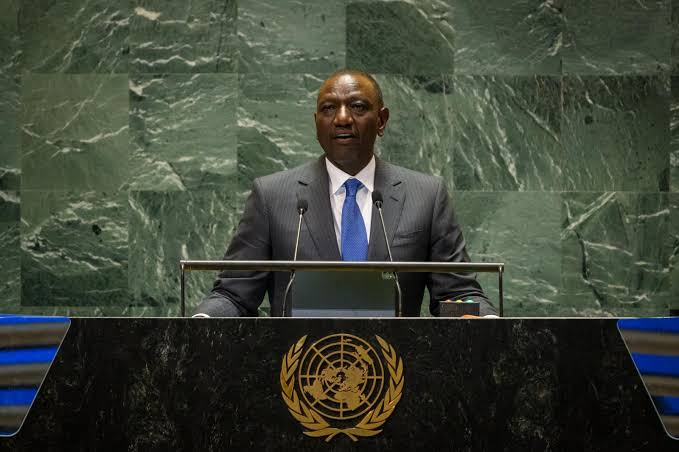
President William Ruto has warned that the global debt crisis is increasingly becoming a children’s rights issue, with rising debt repayment obligations threatening access to essential services such as healthcare, education and nutrition.
Speaking at the High-Level Dialogue on Debt, Development, and the Next Generation in New York, Ruto said governments’ decisions on debt management have a direct impact on children’s well-being and future opportunities.
“Debt is not just an economic issue; it’s a children’s rights issue. When interest payments take priority, hospitals and social programs suffer, impacting children’s future,” Ruto said.
The President’s remarks come against the backdrop of growing concerns over the impact of debt burdens on public spending in developing countries.
Reports, including UNICEF’s State of the World’s Children 2025, indicate that several low- and middle-income countries are directing significant resources towards debt repayment, limiting funding available for essential services.
The UNICEF report, titled Ending Child Poverty – Our Shared Imperative, reveals that more than one in five children, equivalent to 417 million children in low- and middle-income countries, experience severe deprivation in at least two essential areas critical to their health, development and well-being.
Released on November 20, 2025, to mark World Children’s Day, the report draws on data from more than 130 countries and examines child poverty across six key areas: education, health, housing, nutrition, sanitation and water.
According to the report, 118 million children face severe deprivation in three or more areas, while 17 million experience deprivation in at least four areas.
Sanitation is identified as the most widespread and severe deprivation, with 65 per cent of children in low-income countries lacking access to a toilet.
The report further highlights that the highest rates of multidimensional child poverty are concentrated in Sub-Saharan Africa and South Asia.
Although progress was recorded between 2013 and 2023, when the proportion of children experiencing at least one severe deprivation declined from 51 per cent to 41 per cent, UNICEF warns that progress is now slowing.
Climate-related disasters, armed conflicts and declining development assistance are among the key threats to efforts to reduce child poverty.
Four in five children worldwide are exposed to at least one extreme climate hazard each year, while approximately 19 per cent of the world’s children lived in an active conflict zone in 2024, double the proportion recorded three decades earlier.
UNICEF has called on governments to make the eradication of child poverty a national priority by incorporating children’s needs into economic policies and public budgets.
It also recommends expanding social protection programmes, including direct cash support for vulnerable families, and improving access to healthcare, education, clean water and sanitation.
The agency further advocates for decent work and greater economic security for parents and primary caregivers as part of efforts to address the underlying causes of child poverty.
Ruto’s remarks place the global debt burden within a broader development debate, highlighting the need to balance debt obligations with investments in essential public services and the long-term well-being of children.