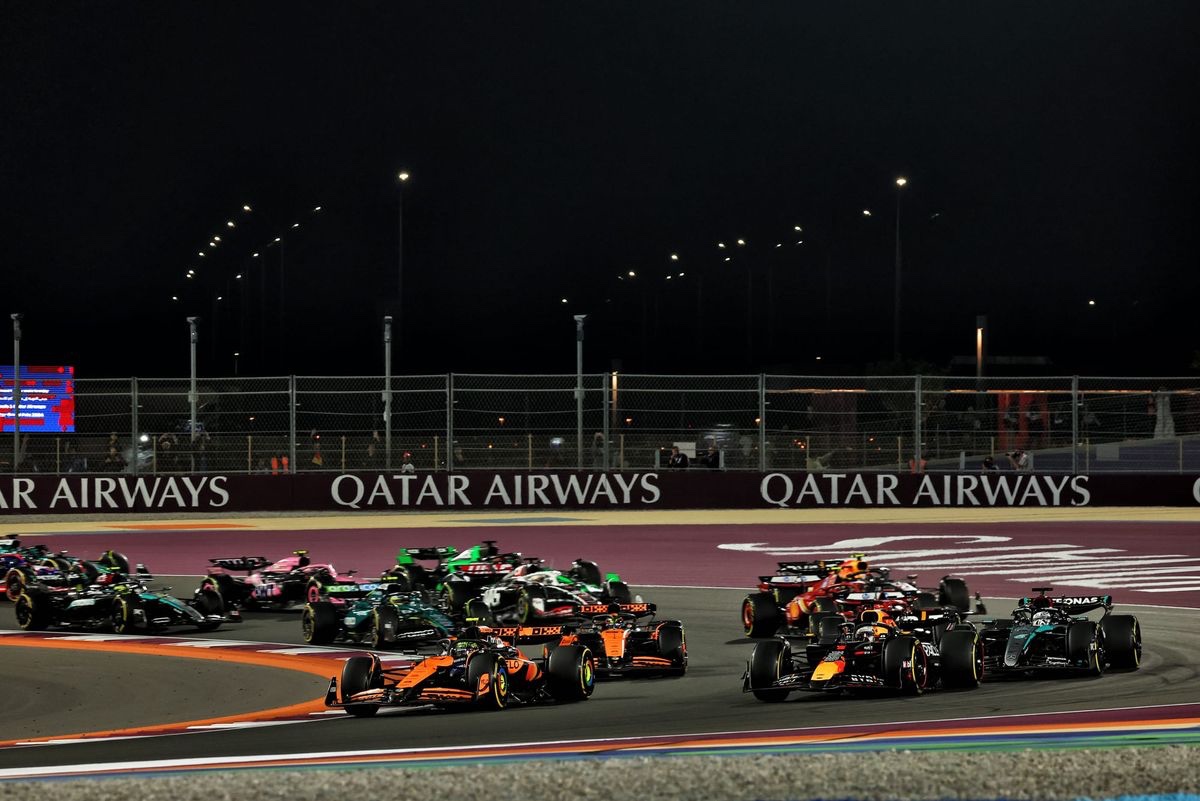
The 2026 Qatar Grand Prix weekend begins on Friday, November 27, with Formula 1 drivers facing a mandatory minimum of two pit stops in Sunday’s race after Pirelli introduced a 27-lap limit on every tyre set at the Lusail International Circuit.
The restriction, agreed upon by Pirelli and the FIA, means drivers cannot complete more than 27 laps on a single set of tyres throughout the weekend. With Sunday’s race scheduled to cover 57 laps, every driver will be required to make at least two pit stops.
The measure is a precautionary response to the demands of the Lusail circuit, where high-speed corners subject tyres to sustained energy loads, thermal stress and significant tread wear.
Unlike a conventional race weekend, teams must monitor tyre mileage across all track sessions, including practice and qualifying. Laps completed under Safety Car and Virtual Safety Car conditions will also count towards the permitted mileage.
For sessions outside the Grand Prix, even a lap that has been started but not completed will count as a full lap. During the race, all laps completed between the start signal and the end-of-session signal will count.
The 27-lap limit is an increase from the 25-lap restriction imposed during the 2025 Qatar Grand Prix. Pirelli attributed the adjustment to the lower aerodynamic loads generated by the 2026 generation of cars and further reinforcement of the tyre construction.
However, the supplier maintained that the circuit’s characteristics still require strict tyre management to prevent excessive wear and protect tyre integrity.
Lusail features 16 corners across its 5.419-kilometre layout, with its succession of high-speed turns placing considerable demands on tyres, particularly the front-left. The relatively smooth track surface and high temperatures can also encourage graining, a condition that contributes to additional wear.
For the weekend, Pirelli has selected its three hardest dry-weather compounds: C1 hard, C2 medium and C3 soft. Intermediate and full wet-weather tyres will also be available should conditions require them.
Drivers must use at least two different slick compounds during the race if conditions remain dry, while the FIA has designated the hard and medium compounds as mandatory race tyres.
Although the two-stop requirement removes the possibility of a conventional one-stop strategy, teams retain flexibility over when to make their stops and how to distribute their tyre sets.
Safety Car interventions could also influence those decisions, as an early stop may leave teams needing an additional visit to the pits to complete the remaining distance without exceeding the mileage limit on their available sets.
The restriction returns after a similar measure was introduced at the 2025 Qatar Grand Prix, when each tyre set was limited to 25 laps. Max Verstappen won that race for Red Bull, finishing ahead of Oscar Piastri, while Carlos Sainz completed the podium for Williams.
Last year’s event also featured a Formula 1 Sprint, unlike this season’s conventional Grand Prix format. The absence of the Sprint gives teams additional opportunities to assess tyre performance during practice and manage the mileage of their allocated sets ahead of Sunday’s race.
Friday’s programme features the opening practice sessions, followed by final practice and qualifying on Saturday. The 57-lap Grand Prix is scheduled for Sunday, November 29, at 7pm local time.
The Qatar event is the 22nd and penultimate round of the 2026 Formula 1 season, with the championship heading towards its final race in Abu Dhabi in December.
Verstappen arrives as a three-time consecutive Qatar Grand Prix winner, having triumphed at Lusail in 2023, 2024 and 2025. The Dutchman will be seeking to extend that record as teams navigate the additional challenge of the mandatory tyre limit.