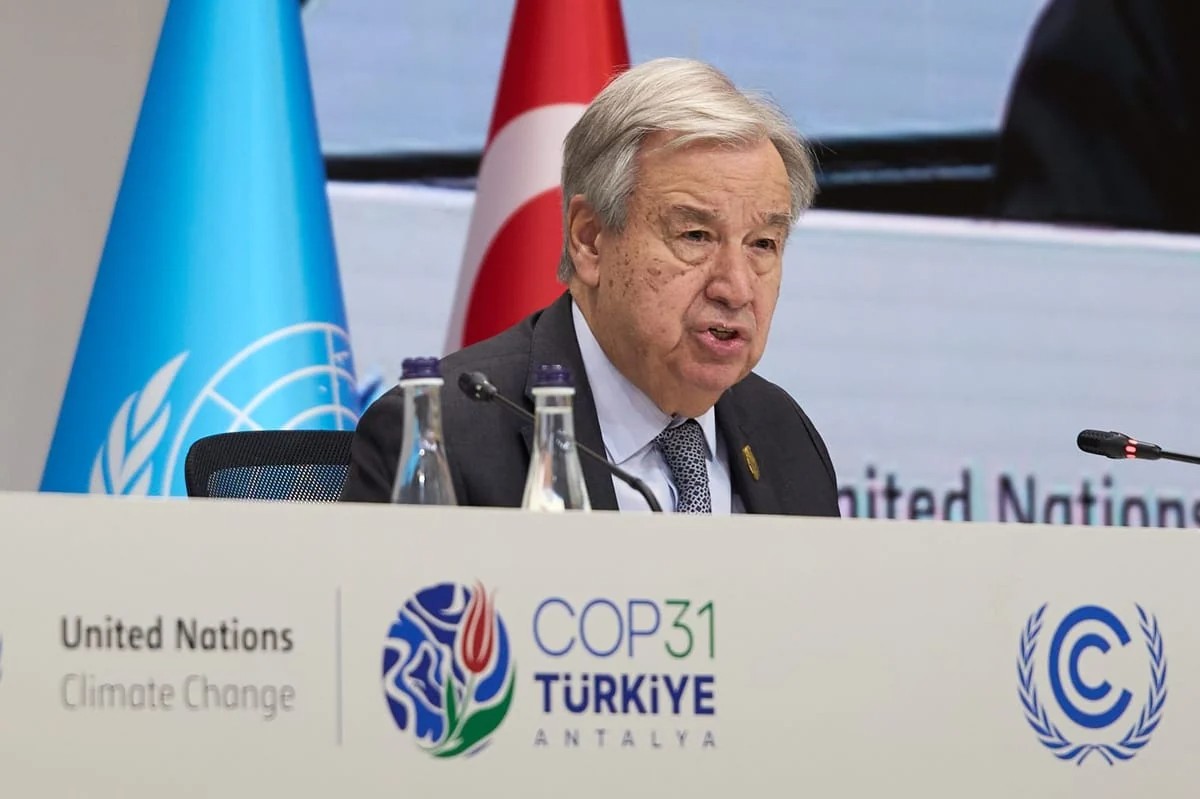
United Nations Secretary-General António Guterres has expressed disappointment after the COP31 climate summit ended without consensus on an overarching agreement, warning that governments must intensify efforts to address global warming.
In a statement issued in New York on Sunday, November 22, 2026, Guterres said the failure to reach a common position was a setback for international climate negotiations but did not change the scientific evidence on the urgency of the crisis.
“There may be no consensus in the negotiating room. There is no ambiguity in the science,” he said, pointing to rising temperatures, intensifying climate extremes and persistently high greenhouse gas emissions.
He warned that the world was approaching an overshoot of the 1.5-degree Celsius global warming threshold established under the Paris Agreement, adding that the opportunity to keep any overshoot limited and short-lived was rapidly narrowing.
The talks in Antalya, Türkiye, concluded on Sunday after running more than 50 hours beyond their scheduled closing time, with participating countries unable to agree on the proposed Antalya Pact, an overarching political decision intended to guide the conference's collective response to climate change.
The main disagreement centred on whether the final agreement should explicitly address fossil fuels, with countries divided over the pace and terms of the transition away from coal, oil and natural gas.
The proposed text did not include a direct reference to fossil fuels, prompting objections from the European Union, the United Kingdom, Norway and several climate-vulnerable countries, which argued that the agreement did not reflect the urgency of reducing emissions.
Russia and Saudi Arabia opposed including explicit language on fossil fuels, with disagreements also extending to carbon capture and storage and the financial support required by developing countries.
Guterres identified continued dependence on coal, oil and natural gas as a major driver of the climate crisis, arguing that it was worsening climate disruption while exposing economies to energy price shocks and undermining energy security.
He called on governments to accelerate the transition away from fossil fuels, recalling that countries had committed at COP28 in Dubai in 2023 to pursue a just, orderly and equitable transition.
The UN chief also urged countries to build on roadmaps advanced by Brazil's COP30 presidency on transitioning away from fossil fuels and reversing deforestation and forest degradation.
On climate financing, Guterres called on developed countries to fulfil their commitments to increase adaptation funding and ensure assistance reaches vulnerable communities.
He specifically urged wealthier nations to deliver on their commitment to lead on tripling adaptation finance, saying countries that contributed least to global emissions should not be left to face the worst consequences of climate change alone.
He further called for deep and rapid emissions reductions during the current decade, with major emitting countries taking the lead in cutting greenhouse gas emissions.
The outcome also raised concerns among African representatives over the continent's recognition and access to climate financing.
Kenya's delegation criticised the proposed decision for failing to specifically recognise Africa's special needs and circumstances, arguing that countries with greater responsibility for emissions should provide adequate support to vulnerable nations.
Despite the failure to agree on the overarching pact, COP31 recorded progress through separate negotiations and voluntary initiatives.
Nearly 100 countries supported a voluntary goal to increase electricity's share of global final energy consumption to 35 per cent by 2035.
The conference also advanced initiatives on just transition, climate adaptation, methane reduction and the protection of forests and oceans, although these developments did not replace the broader political agreement that remained unresolved.
Guterres said the true measure of climate action would depend on what governments deliver beyond international negotiations, including expanding clean energy, modernising electricity grids, reducing methane emissions, restoring forests and protecting communities from extreme weather.
The Paris Agreement, adopted in 2015, commits countries to holding the increase in global average temperatures to well below 2 degrees Celsius above pre-industrial levels while pursuing efforts to limit it to 1.5 degrees Celsius.
The failure to reach consensus at COP31 does not cancel the agreement or commitments adopted at previous climate conferences.
Ethiopia is scheduled to host COP32 in 2027, where countries will continue discussions on outstanding climate commitments and implementation.
Guterres urged civil society organisations, young people, Indigenous Peoples, scientists and frontline communities to continue demanding action and holding governments and companies accountable, reaffirming the United Nations' commitment to addressing the climate crisis.