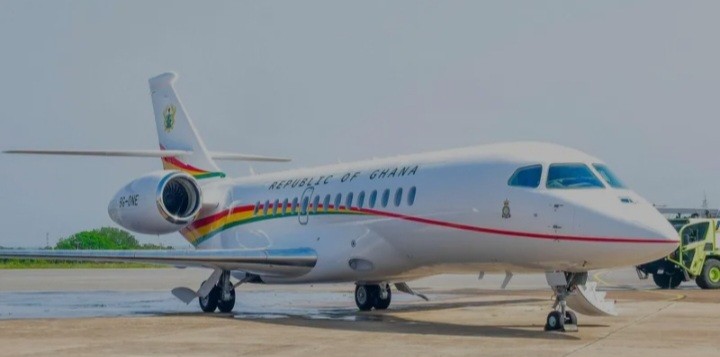
Ghana's decision to spend more than $60 million on a new presidential jet has triggered a heated political debate, with President John Mahama's administration facing questions over its spending priorities at a time when many citizens are still struggling with the cost of living.
The arrival of the French-made Falcon 6X has reignited discussions about government accountability, economic recovery and the responsibility of leaders to balance official expenditure against the needs of ordinary citizens.
Although the government maintains that the purchase is necessary to improve presidential travel and replace an ageing aircraft, critics argue that the money could have been directed towards sectors facing serious challenges, including healthcare, education and employment.
Political debate over presidential jet purchase
The aircraft, manufactured by French aerospace company Dassault Aviation, was delivered to the Ghana Air Force on Monday at a reported cost of $61 million.
Its arrival was marked by a water salute, with Defence Minister Kenneth Adjei welcoming and inspecting the new aircraft. However, the reception quickly became overshadowed by public criticism over the amount spent and whether the purchase was necessary at this particular time.
The controversy has also placed Mahama under political pressure because of his previous position on the acquisition of a new presidential aircraft.
While in opposition, Mahama and senior figures in his National Democratic Congress (NDC) criticised proposals to purchase a new presidential jet, raising concerns about the government's priorities when many Ghanaians were experiencing economic hardship.
The opposition has now turned that argument against his administration, questioning why an expenditure previously considered unnecessary has become justifiable after a change of government.
Opposition Member of Parliament Samuel Abu Jinapor accused the NDC of double standards, arguing that a change in political leadership should not change the principles used to judge public spending.
He further questioned the timing of the purchase, pointing to persistent economic difficulties, youth unemployment and the rising cost of living.
Jinapor also called for greater transparency regarding the procurement process, the financing arrangements and the justification for spending such a significant amount on the aircraft.
The criticism has extended beyond political circles, with some Ghanaians taking to social media to question whether the government could have achieved more by investing the money in public services.
Public criticism and social media reactions
One social media user argued that the amount could have supported the recruitment of more than 100,000 nurses and 200,000 teachers, highlighting the competing demands facing the government.
However, the administration has rejected claims that the purchase represents misplaced priorities, insisting that Ghana's economic position has improved significantly since the period when the NDC opposed a similar acquisition.
Peter Lanchene Toobu, chairman of Parliament's Defence Committee, said the party had never rejected the idea of acquiring a new presidential aircraft.
Instead, he argued that its earlier opposition was based on the economic conditions prevailing at the time, when Ghana was experiencing serious financial difficulties and seeking a $3 billion bailout from the International Monetary Fund (IMF).
According to Toobu, the country's improved economic stability and stronger currency have created a more favourable environment for the purchase.
He further maintained that the aircraft was acquired without borrowing, arguing that improved economic conditions have made imports more affordable.
Government spokesperson Kwakye Ofosu also defended the decision, pointing to declining prices of construction materials and lower borrowing costs as indicators of economic improvement.
He cited the falling price of cement as an example, saying a bag that cost 115 cedis during the 2024 campaign period was now selling for about 80 cedis.
The government has also explained that the aircraft was acquired as part of a wider military aviation modernisation programme approved by Parliament in December last year. The programme includes the purchase of four helicopters from Airbus.
Beyond the political debate, the government says the new Falcon 6X addresses operational challenges associated with the country's previous presidential aircraft, a 16-year-old Falcon 900EX.
Operational benefits of the new aircraft
The older aircraft had reportedly experienced recurring maintenance problems, including corrosion and fuel tank leakages. It was also grounded in France for several months in 2025 while undergoing repairs.
Officials argue that the replacement will improve the reliability of presidential travel, with the Falcon 6X offering a longer flying range that reduces the need for refuelling stops during international journeys.
Questions have also emerged over claims that the new aircraft contains a dedicated bedroom and bathroom, with some critics questioning the level of luxury provided at public expense.
However, Ofosu dismissed the claims, saying the aircraft does not have a dedicated bathroom or bedroom.
He explained that its reclining seats can be converted into sleeping arrangements but rejected suggestions that the president had been provided with elaborate private facilities.
"There certainly is no bathroom. President Mahama has no intention of bathing in the air," Ofosu said.
Ultimately, the controversy surrounding the Falcon 6X goes beyond the cost of purchasing an aircraft. It raises broader questions about government accountability, political consistency and how leaders determine which public investments deserve priority.
For the Mahama administration, the challenge is to convince Ghanaians that the purchase is both necessary and affordable, rather than a departure from the principles it previously defended while in opposition.
While replacing an ageing aircraft may be justified on operational grounds, the public reaction demonstrates that economic recovery does not automatically remove scrutiny over government spending.