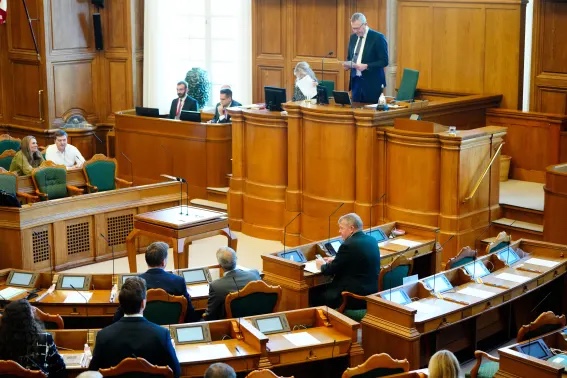
Denmark’s parliament has approved a security agreement with Greenland and the United States, paving the way for an expanded American military presence in the Arctic in a move aimed at easing months of diplomatic tensions over President Donald Trump’s push to bring the strategically important island under US control.
The agreement received unanimous backing on Thursday, November 19, with all 109 lawmakers present in Denmark’s 179-member parliament, the Folketing, voting in favour. Greenland’s parliament had also approved the deal earlier in November, with 16 votes in support and seven abstentions.
The Danish vote completes the parliamentary approval process required by both sides, with the agreement set to enter into force once Denmark formally notifies Washington through a diplomatic note confirming that the necessary procedures have been completed.
Danish Prime Minister Mette Frederiksen welcomed the approval, describing it as a significant milestone following a difficult negotiating process.
“Today is a big day,” Frederiksen wrote on Facebook, adding that the agreement respects Denmark’s sovereignty and territorial integrity as well as Greenlanders’ right to self-determination.
US Ambassador to Denmark Kenneth Howery also welcomed the parliamentary backing, saying it paved the way for the agreement to take effect. He described the deal as an accomplishment that modernises the security partnership and strengthens the defence of the United States, Denmark, Greenland and NATO.
The agreement was signed by Trump and Danish and Greenlandic leaders in New York on September 22 following months of negotiations triggered by the US president’s repeated calls for Greenland to become part of the United States.
Under the arrangement, which supplements a 1951 defence agreement between Washington and Copenhagen, the United States can modernise and expand its activities at the existing Pituffik Space Base in northwestern Greenland.
It also provides for American defence areas at Narsarsuaq in southern Greenland and Mestersvig in the east, subject to agreement between the parties. Further military installations can be established through mutual consent.
The deal strengthens American military access to Greenland and supports greater NATO engagement in the Arctic, including the use of the territory for missile defence through the proposed Golden Dome system.
It also introduces a framework for screening investments from third countries in sensitive Greenlandic sectors and activities, addressing concerns over growing Russian and Chinese influence in the region. Only NATO members will be permitted to establish defence areas and maintain a persistent military presence on the island.
However, the agreement does not transfer Greenland to American control. It reaffirms Denmark’s sovereignty and recognises Greenlanders’ right to self-determination under international law.
The arrangement is also designed to remain in force if Greenland eventually becomes independent, provided the future state remains in NATO and assumes the obligations under the agreement.
Trump’s earlier refusal to rule out military or economic force to acquire Greenland had triggered a diplomatic crisis within NATO, straining relations between Washington and Copenhagen, both members of the alliance.
Greenland, an autonomous territory within the Kingdom of Denmark with approximately 57,000 residents, occupies a strategic position between North America and Europe, making it important for military surveillance and defence across the Arctic and North Atlantic.
Despite the approval, questions remain over whether the agreement will end Washington’s ambitions for greater influence over the island.
University of Copenhagen political science professor Mikkel Vedby Rasmussen warned that the deal could allow the United States to demand greater influence over security decisions and the extraction of strategic resources.
Other experts have argued that the agreement does not significantly expand American military access beyond existing arrangements, leaving its long-term implications for Greenland’s political and security future open to debate.