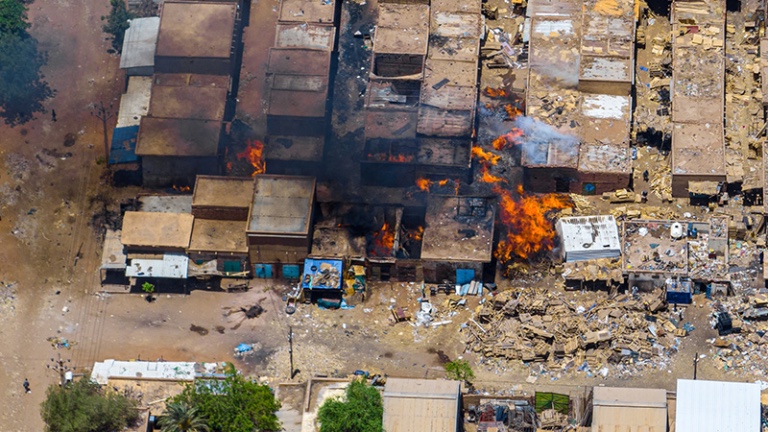
Amnesty International has called for an investigation into a series of drone strikes by Sudan’s Rapid Support Forces (RSF) that allegedly killed at least 37 civilians and injured 10 others in El Obeid, North Kordofan State.
The rights organisation said the attacks, which occurred between June and August 2026, targeted residential areas and key civilian infrastructure, including electricity facilities, fuel stations and the city’s main market.
Amnesty said the pattern of attacks raises concerns that the RSF may have committed war crimes, particularly because its investigation found no identifiable military objectives near the locations struck.
Nine Drone Strikes Investigated
Nine drone strikes investigated
Amnesty International said it investigated nine RSF drone strikes in El Obeid and surrounding areas.
Three of the attacks struck residential neighbourhoods, while four targeted civilian infrastructure. Two other strikes targeted moving vehicles.
According to the organisation, witnesses interviewed during the investigation reported seeing or hearing drones shortly before or after the explosions.
The investigation involved interviews with 29 people from El Obeid, including victims, relatives of victims, eyewitnesses and residents. Amnesty also examined photographs, videos, satellite imagery and reports from humanitarian and United Nations agencies.
El Obeid, the capital of North Kordofan, remains under the control of the Sudanese Armed Forces (SAF) and allied forces.
The RSF began carrying out drone attacks in the city in October 2025, but Amnesty said the attacks intensified significantly in June 2026 amid reports that the paramilitary group was preparing for a ground offensive.
Residential Areas Among Targets
Residential areas among targets
One of the deadliest attacks occurred on June 10, when an RSF drone allegedly struck civilians transporting a body for burial at Dalil cemetery in north-western El Obeid.
At least five people were killed and three others injured in the attack.
A separate strike the following day hit a residential home in the Al-Matar neighbourhood, killing at least nine civilians, according to Amnesty.
The organisation quoted a 41-year-old doctor whose home was struck as saying that her husband, uncle and seven neighbours were killed in the attack.
Amnesty also documented a drone strike near the city’s main market on August 12 that killed two civilians and injured five others.
Civilian Infrastructure Damaged
Civilian infrastructure damaged
The attacks also disrupted essential services in El Obeid.
On June 18, an RSF drone strike hit the city’s main electricity station, triggering a fire and causing a widespread power blackout.
Amnesty said satellite imagery confirmed a newly visible burn area at the facility following the attack.
The organisation said the blackout further worsened an existing water and food crisis because electricity disruptions affected water services.
Several fuel stations were also targeted during June and July.
One June 6 strike on the Al-Mithaq fuel station reportedly killed at least five civilians and destroyed several civilian vehicles.
Another attack on the Al-Nahla fuel station on June 22 killed two civilians and damaged five vehicles.
A further strike on the Agip fuel station on June 25 destroyed 10 civilian vehicles, although no civilian deaths were reported.
By July, Médecins Sans Frontières reportedly found that almost no functional fuel stations remained in El Obeid, while the price of petrol had risen to nearly $15 per litre, and potentially higher on the black market.
Amnesty Raises Concern Over Drone Warfare
Amnesty raises concern over drone warfare
Amnesty International Secretary General Agnès Callamard said the attacks should be investigated as potential war crimes and warned that Sudan’s conflict was increasingly involving advanced weapons against civilians and essential services.
She also called on the United Nations and African Union to urgently strengthen civilian protection measures, including consideration of a protection force for Sudan.
Amnesty has previously accused the United Arab Emirates of supplying weapons, ammunition, armoured vehicles and drones to the RSF. The organisation has also reported that the RSF has used Chinese-made Wing Loong II and FeiHong-95 drones.
The UAE has faced repeated allegations concerning its alleged support for the RSF, which it has denied.
RSF Responds to Amnesty Findings
Amnesty said it wrote to the RSF on October 8 regarding its findings.
The RSF responded on October 24, denying responsibility for attacks that caused civilian casualties and instead attributing them to the Sudanese Armed Forces.
According to Amnesty, the RSF did not provide evidence to support the allegations.
However, the group reportedly said it was considering establishing a specialised investigative committee to examine incidents involving civilian casualties and destruction of civilian property, including those in El Obeid.
Amnesty has urged the RSF to immediately stop attacks on civilians and civilian infrastructure.
The organisation also called on the UN, African Union, European Union, Intergovernmental Authority on Development, Arab League, United States, United Kingdom, UAE and other influential actors to push for an immediate ceasefire and strengthen accountability mechanisms in Sudan.
The conflict between the Sudanese Armed Forces and RSF has continued to cause widespread civilian suffering, with attacks on residential areas and essential infrastructure worsening an already severe humanitarian crisis.